

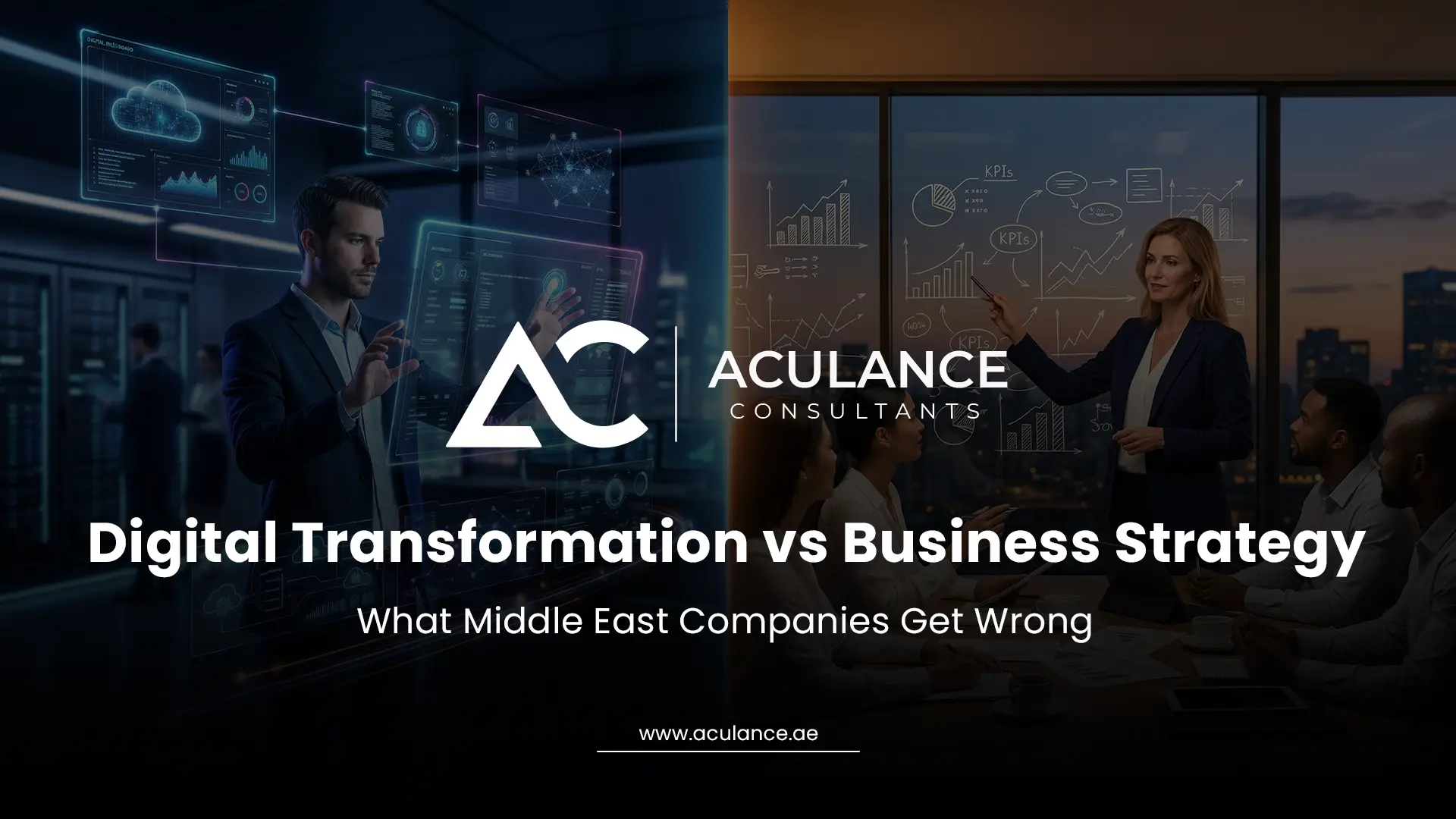
Middle East companies are spending millions on digital transformation; yet many are seeing little to no measurable business impact. primarily due to poor business strategy alignment.
From the UAE’s aggressive digital economy push to Saudi Arabia’s Vision 2030 investments, the region is moving fast. AI adoption is rising, cloud infrastructure is expanding, and organizations are rapidly executing their UAE digital strategy and broader regional initiatives to become digital-first.
But here’s the uncomfortable truth:
Most companies are scaling technology faster than they understand their own business strategy.
And that’s exactly where things start to break.
The Real Problem: Confusing Tools with Strategy
Digital transformation is not a business strategy.
It’s an execution layer.
Yet across the Middle East, many organizations:
- Invest in platforms before defining outcomes.
- Launch digital initiatives without clear KPIs
- Measure success based on implementation, not impact.
The result?
Expensive systems, fragmented operations, and weak ROI.
Business Strategy vs Digital Transformation: The Line Most Companies Blur
Business Strategy = Direction
This defines:
- Where the company is going
- How will it compete
- What drives revenue and profitability
Digital Transformation = Execution
This enables:
- Automation and efficiency
- Data-driven decision-making
- Scalable customer experiences
The Gap That Costs Millions
- Strategy defines value creation.
- Digital defines value delivery.
When these are disconnected, the Middle East digital transformation becomes an activity without outcomes.
The Cost of Getting It Wrong (And Why It’s Worse in the Middle East)
This isn’t just a strategic misstep; it’s a financial and competitive risk.
What misalignment actually leads to:
- Massive capital waste on underutilized tools
- Disconnected customer journeys across channels
- Operational complexity instead of efficiency
- Delayed decision-making due to poor data integration
- Loss of competitive edge in fast-moving markets like the UAE and Saudi Arabia
In a region where speed is a competitive advantage, misalignment doesn’t just slow you down; it pushes you behind.
Why Middle East Companies Keep Making This Mistake
1. Adopt First, Define Later Mentality
In fast-growing markets, there’s pressure to move quickly.
So companies adopt technology first and figure out strategy later.
That rarely works.
2. Leadership Delegates Instead of Owning
Digital transformation is often treated as:
- An IT project
- A marketing upgrade
Instead of what it really is:
A business transformation led by leadership
3. Copy-Paste from Western Markets
What works in the US or Europe doesn’t always work in the GCC.
Differences include:
- Customer expectations
- Buying behavior
- Market maturity
- Regulatory frameworks
Yet many companies replicate strategies without adapting them.
4. Obsession with Quick Wins
Short-term metrics (traffic, app downloads, tool adoption) are prioritized over:
- Profitability
- Customer lifetime value
- Long-term growth
Digital Maturity ≠ Business Success
Here’s where most companies misjudge themselves:
We’ve implemented AI, analytics, and automation. We’re digitally mature.
But:
- Are you increasing revenue?
- Are you reducing costs?
- Are you improving customer retention?
If not, you’re not transforming, you’re just digitizing.
Being digitally advanced without strategic alignment is just expensive complexity.
Real Market Scenarios (Middle East Context)
Let’s make this real:
- A UAE-based retail brand invests heavily in omnichannel platforms—but fails to integrate inventory and customer data. Result: poor customer experience, lost sales, and no contribution to sustainable business growth.
- A Saudi financial institution adopts AI tools—but doesn’t align them with customer journey improvements. Result: high investment, minimal CX impact.
- A real estate firm increases digital ad spend—but lacks a conversion strategy. Result: leads increase, revenue doesn’t.
Same region. Same ambition.
Different outcomes because of strategy alignment.
Where Digital Transformation Actually Breaks
At the Strategy Level
- No clear business objectives
- No defined success metrics
At the Execution Level
- Tools implemented in silos
- Poor integration across systems
At the Performance Level
- No ROI tracking
- No optimization loop
The Digital ROI Alignment Model (A Practical Framework)
To fix this, organizations need more than advice; they need a system.
1. Define Revenue-Linked Outcomes
Not go digital but:
- Increase revenue by X%.
- Reduce CAC by X%
- Improve retention by X%
2. Map Every Initiative to a KPI
If a tool doesn’t impact a metric, it doesn’t belong in your strategy.
3. Prioritize High-Impact Areas
Focus on:
- Customer experience
- Revenue-driving channels
- Operational efficiency
4. Integrate Across Functions
Break silos between:
- Marketing
- Operations
- Technology
- Leadership
5. Build a Continuous Optimization Loop
Measure → Analyze → Improve → Scale
KPIs That Actually Matter (And What Most Companies Ignore)
Stop tracking vanity metrics. Focus on:
- Revenue growth rate
- Customer Acquisition Cost (CAC)
- Customer Lifetime Value (LTV)
- Conversion rates
- Cost efficiency
- Digital ROI
If your dashboards don’t reflect these, your strategy isn’t aligned.
Common Myths That Are Costing Companies Millions
- More tools = better performance
- Digital transformation is IT’s job.
- Implementation = success.
Reality:
Execution without strategy is just structured inefficiency.
Leadership Is the Real Differentiator
The companies that succeed don’t just invest in technology, they align leadership.
What winning organizations do differently:
- CEO-level ownership of transformation
- Clear business-first vision
- Cross-functional accountability
- Data-driven decision-making culture
Without this, transformation stalls no matter how advanced the tools are.
Before vs After Alignment
| Without Alignment | With Alignment |
|---|---|
| Tool-driven decisions | Strategy-driven decisions |
| High spend, low ROI | Measurable growth |
| Fragmented systems | Integrated ecosystem |
| Siloed teams | Unified execution |
| Short-term wins | Sustainable growth |
What Winning Companies in the Middle East Will Do Next
The next wave of leaders in the UAE and Saudi Arabia will:
- Integrate AI into core business strategy not as an add-on.
- Build data-driven operating models.
- Focus on customer-centric transformation.
- Prioritize long-term value over short-term metrics.
Final Takeaway
If your digital transformation isn’t driving measurable business growth, you don’t have a technology problem.
You have a strategy problem.
Digital transformation only creates value when it is:
- Aligned with business goals
- Measured with the right KPIs
- Driven by leadership
- Continuously optimized
Most companies don’t realize where they’re losing ROI until it’s too late.
If your digital investments aren’t delivering measurable results, it’s time to identify the gaps.
Start with a strategy–digital alignment audit to uncover inefficiencies, optimize investments, and turn transformation into sustainable business growth.