
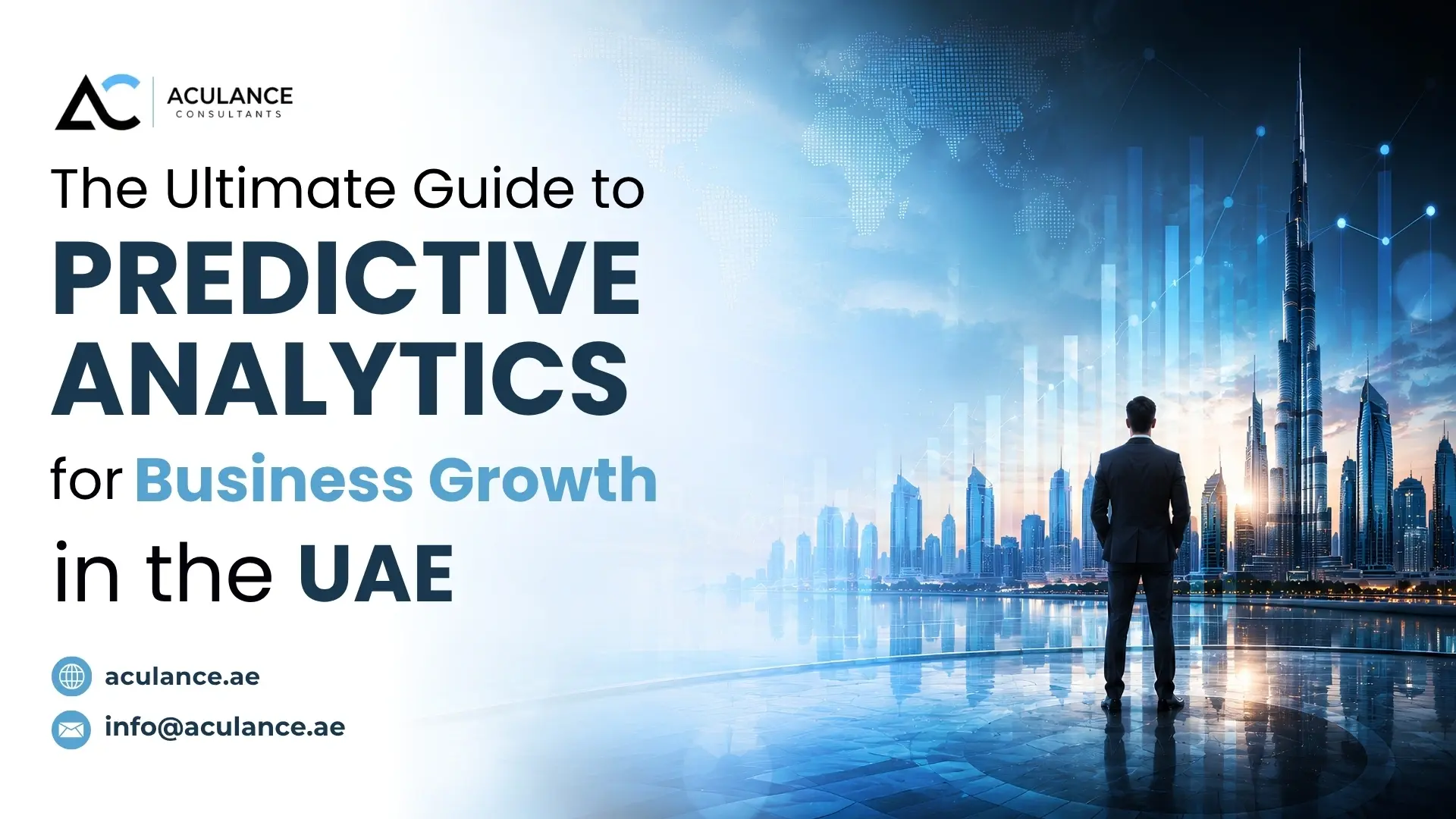
For UAE SMEs and startups, growth depends on making smarter decisions before opportunities are missed. Traditional reporting tells you what happened in the past, but predictive analytics for business helps you understand what is likely to happen next.
By analyzing historical data, customer behavior, market patterns, and operational information, predictive analytics can help businesses forecast demand, identify high-value customers, improve sales, reduce risks, and make more informed decisions.
For growing companies in the UAE, this can turn existing business data into a strategic growth asset.
What Is Predictive Analytics for Business?
Predictive analytics for business is the use of data, statistics, artificial intelligence (AI), and machine learning to identify patterns and forecast possible future outcomes.
In simple terms, predictive analytics helps answer questions such as:
- Which customers are most likely to buy?
- Which leads are most likely to convert?
- What could future sales look like?
- Which customers may stop using a service?
- What products could experience higher demand?
- Where might business risks occur?
Unlike traditional business reporting, which focuses primarily on historical performance, predictive analytics looks forward.
For example, a UAE startup can analyze previous sales, customer interactions, website activity, and seasonal patterns to estimate which products or customer segments are likely to generate more revenue in the future.
The predictions are not guarantees. Instead, they provide data-driven probabilities that help business leaders make better decisions.
Why Is Predictive Analytics Important for UAE SMEs and Startups?
The UAE has a highly competitive and digitally evolving business environment. SMEs and startups often need to increase revenue while controlling costs and making the most of limited resources.
This makes data-driven decision-making particularly valuable.
Business predictive analytics can help companies move from reactive decision-making to proactive planning.
Instead of waiting for sales to decline, businesses can identify potential warning signals. Instead of treating every lead equally, sales teams can prioritize prospects with stronger conversion potential.
The result can be faster decision-making, more efficient resource allocation, and improved business planning.
What Are the Benefits of Predictive Analytics for Business?
| Benefit | How It Helps UAE SMEs |
| Sales Forecasting | Predict future sales and improve business planning. |
| Customer Retention | Identify customers at risk of leaving. |
| Lead Scoring | Prioritize leads with higher conversion potential. |
| Marketing Optimization | Identify audiences and campaigns likely to perform better. |
| Risk Management | Detect potential risks and unusual patterns. |
| Decision-Making | Use data-driven insights for better business decisions. |
How Does Business Predictive Analytics Work?
A typical predictive analytics process includes several stages:
Data Collection → Data Preparation → Analysis → Predictive Modeling → Forecasting → Business Action → Monitoring
- Data Collection
Businesses collect relevant data from CRM systems, websites, sales platforms, customer-service tools, financial systems, and marketing channels. - Data Preparation
Collected data is cleaned, organized, and checked for errors or missing information so it can be used reliably for analysis. - Analysis
The data is analyzed to identify patterns, trends, relationships, and factors that may influence future business outcomes. - Predictive Modeling
AI and machine-learning algorithms use historical data to build models that can identify patterns and estimate likely future outcomes. - Forecasting
The predictive model generates forecasts, such as expected sales, customer demand, lead conversions, or potential customer churn. - Business Action
Businesses use these predictions to make informed decisions, improve strategies, allocate resources, and respond to potential opportunities or risks. - Monitoring
Models and results are continuously monitored to measure accuracy, identify changes, and update predictions as new data becomes available.
What Are Common Predictive Analytics Use Cases?
Businesses can apply predictive analytics across different functions. Common use cases include:
Sales Forecasting
Predict future sales and identify changing revenue patterns.
Customer Churn Prediction
Identify customers who may be likely to leave and create proactive retention strategies.
Predictive Lead Scoring
Prioritize prospects according to their predicted likelihood of conversion.
Demand Forecasting
Estimate future product or service demand to improve planning.
Customer Segmentation
Identify groups of customers with similar behaviors, preferences, or predicted value.
Financial Forecasting
Support revenue, expense, and cash-flow planning using historical and current business data.
Fraud and Anomaly Detection
Identify unusual transactions or behaviors that may require investigation.
How Can AI Improve Predictive Analytics?
Artificial intelligence and machine learning can expand the capabilities of predictive analytics by processing large volumes of structured and unstructured data.
For example, an AI-powered predictive system could analyze customer interactions, purchase history, website engagement, and marketing activity to estimate the probability of a future purchase.
However, AI should not be treated as a replacement for human expertise.
Successful business predictive analytics combines technology with high-quality data, business knowledge, appropriate governance, and human oversight.
For SMEs, starting with a specific business problem is often more effective than implementing AI simply because it is available.
How Can UAE SMEs Choose the Right Predictive Analytics Services?
Selecting the right predictive analytics services provider can significantly influence the success of an analytics project.
Before choosing a provider, consider the following:
Business understanding: Does the provider understand your business objectives rather than focusing only on technology?
Data integration: Can the solution connect with your existing CRM, ERP, marketing, sales, or financial systems?
AI expertise: Does the provider have experience with machine learning and predictive modeling?
Scalability: Can the solution grow as your business and data requirements increase?
Security and governance: Are appropriate measures in place to protect business and customer data?
Usability: Can your team understand and act on the insights?
Measurable results: Will the provider define KPIs and demonstrate how the solution contributes to business outcomes?
A strong analytics partner should be able to explain complex models in simple business language.
How Much Do Predictive Analytics Services Cost in the UAE?
There is no standard price for predictive analytics services because costs vary depending on the project’s objectives, data volume, integrations, model complexity, customization, infrastructure, and ongoing support.
For an SME or startup, the best approach is often to start small.
For example, a business might initially focus on one measurable objective such as improving lead conversion, forecasting sales, or reducing customer attrition.
Once the business demonstrates value from the initial project, it can expand predictive analytics across other departments.
What Challenges Should Businesses Consider?
Predictive analytics can provide valuable insights, but businesses should understand its limitations.
Poor-quality or incomplete data can affect prediction accuracy. Historical patterns may also change because of market conditions, customer preferences, economic factors, or changes in business strategy.
Predictive models therefore require regular monitoring and improvement.
Businesses should also consider data privacy, security, governance, and employee adoption.
The technology alone does not guarantee results. Successful implementation requires reliable data, clearly defined objectives, appropriate models, and people who know how to use the resulting insights.
Is Predictive Analytics Worth It for UAE Startups?
Yes, predictive analytics can be valuable for startups when it is connected to a clear business objective.
Startups do not necessarily need a complex enterprise analytics platform.
A practical starting point could be predicting sales, identifying high-quality leads, understanding customer churn, or forecasting demand.
The key is to focus on a problem where better predictions could create measurable business value.
As the company grows, the analytics capability can grow with it.
What Is the Future of Predictive Analytics in the UAE?
The future of predictive analytics is closely connected to AI, automation, real-time data, and intelligent decision-support systems.
As these technologies become more accessible, SMEs and startups can increasingly use advanced analytics without building every capability internally.
The competitive advantage, however, will not simply come from adopting AI.
Businesses that succeed will be those that use AI and analytics to solve meaningful problems, improve customer experiences, increase operational efficiency, and make faster data-driven decisions.
Conclusion
Predictive analytics for business is no longer limited to large enterprises. UAE SMEs and startups can use predictive insights to understand customers, forecast sales, identify opportunities, manage risks, and make smarter decisions.
The most effective approach is to begin with a specific business challenge and identify how data can help predict what happens next.
With the right strategy, reliable data, and suitable predictive analytics services, businesses can transform historical information into actionable intelligence and build a more proactive approach to growth.
Frequently Asked Questions
What is predictive analytics for business?
Predictive analytics for business uses data, AI, and machine learning to forecast future business outcomes such as sales, demand, and customer behavior.
How can predictive analytics help SMEs?
It helps SMEs improve forecasting, identify valuable leads, reduce customer churn, optimize marketing, and make data-driven decisions.
What is business predictive analytics?
Business predictive analytics uses data and predictive models to anticipate future trends, customer behavior, sales, and business risks.
What are predictive analytics services?
Predictive analytics services include data analysis, predictive modeling, forecasting, AI solutions, dashboards, implementation, and ongoing support.
Is predictive analytics suitable for startups?
Yes. Startups can use predictive analytics for lead scoring, sales forecasting, customer retention, and demand prediction.