

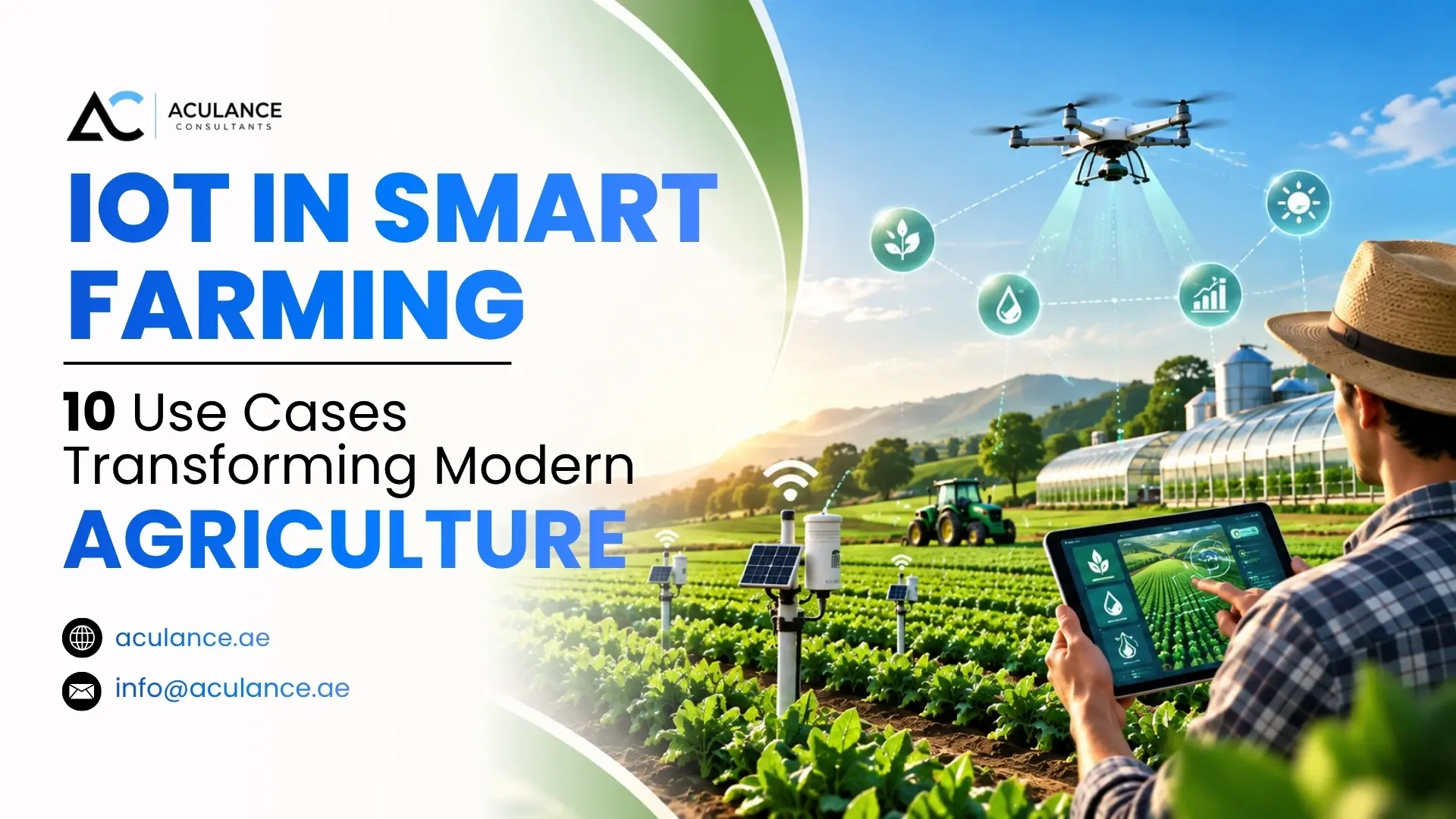
Agriculture is changing rapidly. Farmers today are not only relying on traditional farming knowledge they are also using connected devices, sensors, automation, and real-time data to make smarter decisions.
This is where IoT in smart farming is making a major difference.
The Internet of Things (IoT) connects physical devices such as soil sensors, weather stations, irrigation systems, farm equipment, drones, and livestock trackers to collect and exchange data. Farmers can use this information to understand what is happening on the farm and respond at the right time.
From saving water to monitoring crops and predicting yields, smart farm technology is helping modern agriculture become more productive, efficient, and sustainable.
But how exactly is IoT transforming farming?
Let’s explore 10 important IoT use cases in smart agriculture.
What Is IoT in Smart Farming?
IoT in smart farming refers to the use of connected devices and sensors to monitor, manage, and automate agricultural activities.
For example, a soil-moisture sensor can detect when a field is becoming dry. Instead of watering the entire field on a fixed schedule, a smart irrigation system can use that information to provide water when and where it is actually needed.
In the same way, connected livestock devices can monitor animal activity, while weather sensors can provide real-time information about temperature, humidity, rainfall, and other environmental conditions.
The result is a farm that can operate with better information, less waste, and more automation.
10 IoT Use Cases Transforming Modern Agriculture
1. Precision Farming
Precision farming is one of the most important applications of IoT in agriculture.
Connected sensors can collect information about soil moisture, temperature, nutrients, weather, and crop conditions. Farmers can use this data to understand which areas of a field need water, fertilizer, or other treatments.
Instead of treating an entire field in the same way, farmers can make decisions based on the specific needs of different areas.
Key benefits include:
- Better resource utilization
- Reduced fertilizer and water waste
- Improved crop management
- More informed farming decisions
- Potentially higher productivity
This data-driven approach is helping move agriculture from traditional farming toward smarter and more precise operations.
2. Smart Irrigation
Water is one of the most valuable resources in agriculture. Using too much water increases costs and waste, while too little can negatively affect crops.
IoT-enabled irrigation systems help solve this problem.
Soil-moisture sensors can continuously monitor the amount of water available in the soil. When connected to automated irrigation equipment, these systems can trigger watering based on actual field conditions.
Farmers can also monitor irrigation remotely and receive alerts when something goes wrong.
This makes smart irrigation an important part of sustainable smart farming.
3. Crop Health Monitoring
Healthy crops are essential for a successful harvest. However, identifying crop stress, disease, or nutrient problems early can be difficult when farmers have large fields to manage.
IoT sensors, cameras, drones, and connected monitoring systems can help farmers keep a closer eye on crop conditions.
These technologies can identify changes in plant health and provide useful information for further investigation.
Early detection means farmers can take action before a small problem becomes a larger one.
4. Smart Pest Management
Pests can cause serious damage to crops and reduce agricultural productivity.
IoT technology can help farmers monitor environmental conditions and identify signs of pest activity. Sensors, cameras, and connected monitoring devices can provide information about areas that may require attention.
Instead of applying pesticides across an entire field, farmers can potentially focus treatment where it is needed.
This approach can help reduce unnecessary chemical use while supporting healthier crop management.
5. Livestock Monitoring
IoT is not limited to crops. It is also changing the way farmers manage livestock.
Wearable and connected devices can monitor animal location, movement, activity, and other health-related indicators.
For example, unusual changes in an animal’s activity may indicate that it needs attention. Farmers can receive alerts and investigate the situation without manually checking every animal.
Livestock monitoring can help improve:
- Animal welfare
- Farm productivity
- Early issue detection
- Herd management
- Operational efficiency
For large farms, these technologies can save significant time and make livestock management easier.
6. Smart Greenhouses
Greenhouses provide controlled environments for growing crops, but maintaining the right conditions can require constant monitoring.
IoT makes this process smarter.
Connected sensors can monitor temperature, humidity, light, soil moisture, and other environmental conditions. Automated systems can then adjust irrigation, ventilation, lighting, or temperature controls according to predefined requirements.
This reduces the need for constant manual intervention and helps create more consistent growing conditions.
For commercial growers, smart greenhouse technology can be especially valuable for improving operational efficiency.
7. Weather and Environmental Monitoring
Weather can have a major impact on agricultural operations.
Unexpected rainfall, high temperatures, humidity, or changing weather patterns can affect irrigation, crop health, harvesting, and other farm activities.
IoT weather stations and environmental sensors provide real-time information that farmers can use to make better decisions.
Instead of relying only on general weather forecasts, farmers can access data from their own fields.
This localized information can help answer practical questions such as:
Should I irrigate today?
Is the soil too wet?
Are weather conditions suitable for spraying?
Could extreme temperatures affect my crops?
Having this information at the right time can make farm management more responsive.
8. Farm Equipment Monitoring and Predictive Maintenance
Modern farms depend heavily on machinery and equipment. A breakdown at the wrong time can delay operations and increase costs.
IoT sensors can monitor the condition and performance of connected equipment.
Farm operators can receive alerts about unusual operating conditions, temperature changes, fuel levels, tank levels, or potential maintenance requirements.
This allows farmers to move from a reactive approach fixing equipment after it breaks toward a more proactive approach.
Predictive and preventive maintenance can help reduce downtime, improve equipment utilization, and extend the useful life of agricultural machinery.
9. Remote Farm Management
Farmers don’t always need to be physically present in the field to monitor their operations.
With connected IoT devices and cloud-based platforms, farmers can access important information remotely using smartphones, tablets, or computers.
Depending on the system, they may be able to:
- Monitor soil conditions
- Check irrigation status
- Track equipment
- Receive alerts
- Monitor livestock
- Review environmental data
- Adjust connected systems remotely
This is particularly useful for large farms or operations spread across multiple locations.
Remote management gives farmers greater visibility without requiring them to visit every part of the farm.
10. Supply Chain and Produce Monitoring
IoT can also improve what happens after crops and agricultural products leave the field.
Connected tracking and monitoring technologies can provide visibility throughout the agricultural supply chain.
For temperature-sensitive products, sensors can monitor environmental conditions during storage and transportation. Tracking systems can also improve visibility into where products are and how they are moving.
Better monitoring can support:
- Product quality
- Traceability
- Food safety
- Inventory management
- Reduced spoilage
- More efficient logistics
In this way, IoT can connect different stages of agriculture from production to distribution.
How Smart Farm Technology Works
A typical smart farming system brings several technologies together.
Sensors
Sensors collect information from the farm. Depending on the application, they can measure soil moisture, temperature, humidity, water levels, weather conditions, equipment status, and more.
Connectivity
The collected information needs to move from devices to a central platform. Different farms may use technologies such as cellular networks, Wi-Fi, Bluetooth, LoRaWAN, satellite connectivity, or other wireless solutions depending on their location and requirements.
Cloud and Edge Computing
Data can be processed in the cloud or closer to where it is generated using edge computing.
This allows farmers and agricultural businesses to turn large amounts of sensor data into useful information.
Analytics and AI
Data analytics and artificial intelligence solutions can help identify patterns, detect unusual conditions, and support better decision-making.
Automation
The final step is action.
For example, data from a soil sensor could trigger an irrigation system, or an equipment sensor could generate a maintenance alert.
Together, these technologies create a connected smart farm technology ecosystem.
Benefits of IoT in Smart Agriculture
The adoption of IoT can provide several benefits across farming operations.
Better Resource Management
Farmers can use real-time information to manage water, fertilizer, energy, and other resources more efficiently.
Reduced Waste
Precise monitoring and targeted applications can help reduce unnecessary use of agricultural inputs.
Improved Productivity
Better data can help farmers make timely decisions that support crop and livestock productivity.
Lower Operational Costs
Automation and remote monitoring can reduce unnecessary manual work and help identify problems earlier.
Greater Sustainability
Using resources more efficiently can support more sustainable agricultural practices.
Data-Driven Decisions
Instead of relying only on assumptions or fixed schedules, farmers can make decisions using real-time information from their fields and equipment.
Challenges of Implementing IoT in Agriculture
Although IoT offers significant opportunities, implementing smart farming technology is not always simple.
Connectivity in Rural Areas
Many farms are located in remote areas where reliable internet connectivity may be limited.
Without dependable connectivity, connected devices may not be able to send data consistently.
Initial Investment
Sensors, gateways, connectivity infrastructure, software, and automation equipment can require an upfront investment.
Farmers need to evaluate the expected benefits and choose technologies that match their operational requirements.
Data Management
IoT systems can generate large amounts of information. Farmers need appropriate platforms and analytics tools to turn this data into useful insights.
Security
Connected agricultural equipment and systems must be protected against unauthorized access and other cybersecurity risks.
Integration
A farm may already use different machines, controllers, sensors, and software platforms. Ensuring that these systems work together can be an important part of an IoT implementation.
This is where experienced agriculture solutions providers can play an important role.
Choosing the Right Agriculture Technology Partner
The smart agriculture market includes many technology companies offering sensors, software, automation, connectivity, analytics, and complete farming solutions.
When evaluating smart agriculture companies, farmers and agricultural businesses should look beyond individual devices.
A good technology solution should consider the complete farm environment.
Important factors include:
- Connectivity availability
- Device reliability
- Scalability
- Data security
- Ease of installation
- Integration with existing equipment
- Remote monitoring capabilities
- Long-term maintenance
- Total cost of ownership
Experienced agriculture solutions providers can help organizations identify the right combination of hardware, connectivity, software, and automation for their specific farming requirements.
The Future of Smart Farming
The future of agriculture is becoming increasingly connected.
As IoT, AI, robotics, drones, automation, and advanced analytics continue to develop, farms will gain access to more powerful tools for monitoring and managing their operations.
Imagine a farm where sensors continuously monitor soil conditions, drones inspect crops, irrigation systems automatically respond to moisture levels, livestock devices identify unusual behavior, and farmers manage everything from a single dashboard.
This is the direction in which smart farming is moving.
The goal isn’t simply to add more technology to agriculture. The real goal is to use technology to help farmers produce more efficiently, use resources responsibly, reduce operational challenges, and make better decisions.
IoT is transforming agriculture from a largely manual and reactive industry into a more connected, data-driven, and automated one.
From precision farming and smart irrigation to livestock monitoring, crop health management, equipment maintenance, and supply-chain tracking, IoT has applications across almost every stage of modern agriculture.
For farmers and agricultural businesses looking to adopt smart farm technology, the key is to start with real operational challenges and choose solutions that can grow with their needs.
As more smart agriculture companies and agriculture solutions providers develop connected technologies, IoT will continue to play an important role in building a more productive, efficient, and sustainable future for farming.
Get in touch with us:– https://aculance.ae/contact/