

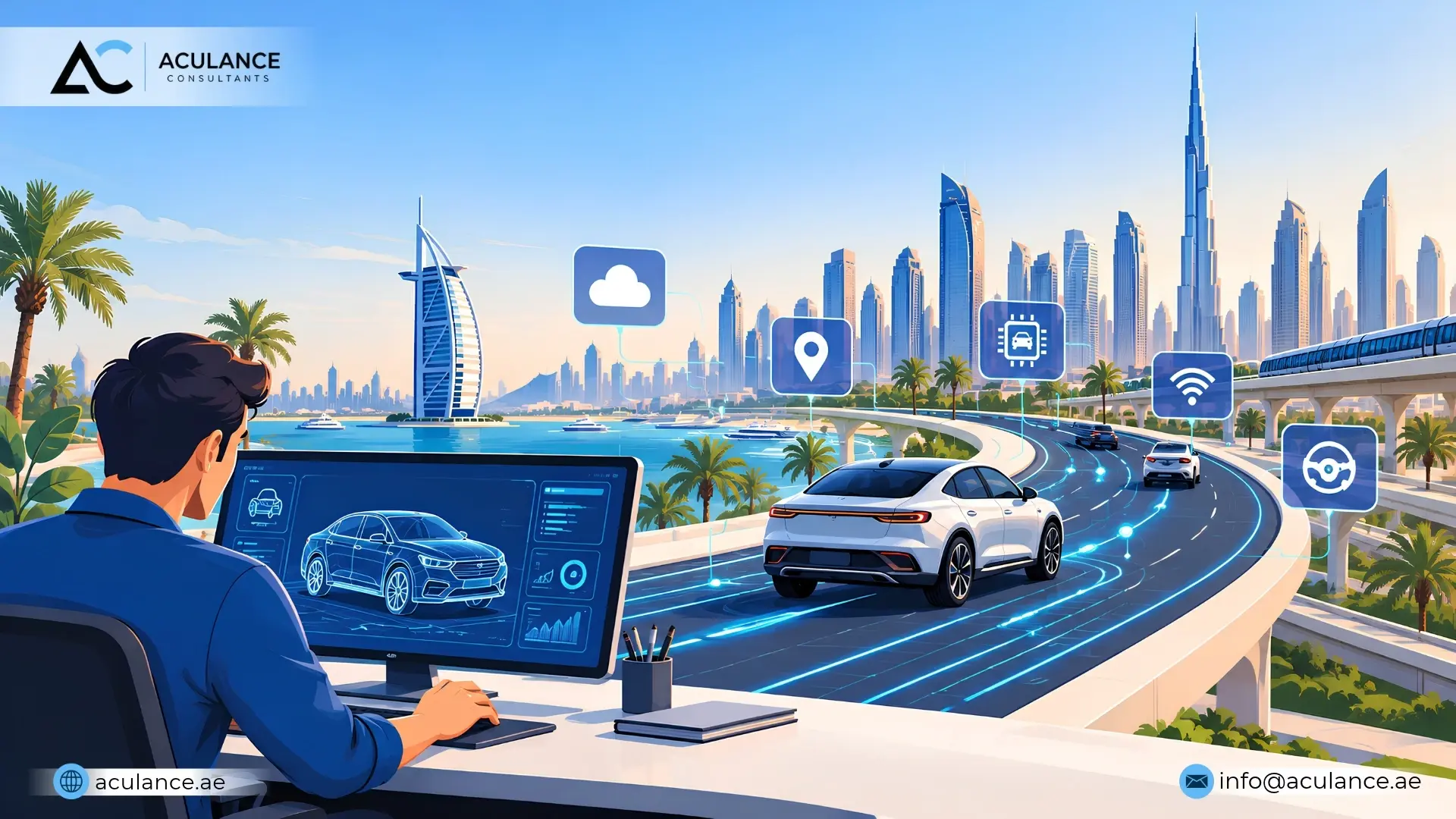
The United Arab Emirates (UAE) is transforming its transportation industry through digital innovation, smart infrastructure, electric vehicles, and intelligent mobility solutions. From Dubai’s smart city initiatives to the growing adoption of connected cars, technology is changing how people travel and how businesses manage transportation.
At the center of this transformation is automotive software development. Modern vehicles rely on software to improve safety, enhance performance, enable connectivity, and deliver personalized driving experiences. Software also helps automotive businesses streamline fleet operations, manage maintenance, and improve customer service.
As the UAE continues to invest in smart mobility and digital transformation, automotive software solutions are becoming increasingly important for vehicle manufacturers, dealerships, fleet operators, logistics companies, and mobility startups.
What Is Automotive Software Development?
Automotive software development is the process of designing, developing, testing, deploying, and maintaining software used in vehicles and automotive-related systems. It includes applications that control vehicle functions, connect vehicles to digital platforms, support driver assistance, and help businesses manage automotive operations.
Depending on the application, automotive software can run directly on vehicle hardware or operate through cloud platforms, mobile applications, and web-based systems.
Common types of automotive software include:
Embedded automotive software: Controls electronic vehicle functions such as engine management, braking, and other systems.
Advanced Driver-Assistance Systems (ADAS): Supports lane departure warnings, parking assistance, and adaptive cruise control.
Infotainment software: Provides navigation, entertainment, voice commands, and smartphone connectivity.
Electric vehicle software: Manages battery performance, charging, and energy consumption.
Fleet management software: Supports vehicle tracking, route planning, and maintenance scheduling.
Connected vehicle platforms: Exchange vehicle information with cloud systems and compatible services.
These solutions help businesses improve vehicle performance, simplify transportation management, and respond to changing customer expectations.
Key Automotive Software Solutions Transforming the UAE
The UAE’s mobility ecosystem includes private vehicles, commercial fleets, electric transportation, and connected infrastructure. Different software solutions support these areas by improving connectivity, vehicle management, and operational efficiency.
| Software solution | Primary purpose | Main benefit |
|---|---|---|
| Connected car software | Connects vehicles to digital platforms | Remote access and connectivity |
| ADAS software | Supports driver assistance | Improved driver awareness |
| EV management software | Monitors batteries and charging | Better energy management |
| Fleet management software | Tracks vehicles and routes | Improved fleet efficiency |
| Dealership software | Manages sales and service operations | Streamlined workflows |
| Predictive maintenance software | Identifies potential vehicle issues | Reduced unexpected downtime |
The right solution depends on business objectives, vehicle types, existing infrastructure, and customer requirements.
Connected Cars and Smart Mobility
Connected cars use communication technologies to exchange information with cloud platforms, mobile applications, other vehicles, and compatible infrastructure. This allows drivers and businesses to access useful information beyond traditional vehicle controls.
In the UAE, connected vehicle technology can support navigation updates, vehicle health alerts, remote access, and traffic-related information.
For example, a connected vehicle application can allow an owner to check vehicle status remotely and receive maintenance reminders. Fleet managers can use similar systems to monitor vehicle locations and operating conditions.
Connected vehicle platforms can also contribute to smart city development by providing information that supports transportation planning. Their effectiveness depends on reliable connectivity, compatible systems, secure data exchange, and appropriate privacy controls.
AI and Advanced Driver-Assistance Systems (ADAS)
Artificial intelligence (AI) is becoming an important part of automotive software development. AI-enabled systems can process information from cameras, sensors, and other vehicle components to identify potential hazards and support driving decisions.
Common ADAS features include lane departure warnings, adaptive cruise control, parking assistance, forward collision warnings, driver attention monitoring, and automatic emergency braking where supported.
These features can help drivers recognize hazards and respond to changing road conditions. In the UAE, where transportation includes busy urban roads and long-distance highways, driver-assistance technologies can provide valuable support.
AI is also used in vehicle diagnostics, traffic analysis, driving pattern analysis, and fleet planning. However, these systems require careful testing and validation. Driver-assistance technology does not replace attentive driving, and its effectiveness depends on sensor performance, road conditions, and system limitations.
Automotive Software for Electric Vehicles
Electric vehicles (EVs) are an important part of the transition toward lower-emission transportation. As electric mobility expands, software helps manage batteries, charging operations, vehicle performance, and energy consumption.
Battery Management Systems (BMS) monitor battery temperature, voltage, and charging conditions to support efficient operation. Charging management software helps drivers locate compatible charging points and monitor charging sessions where supported.
Energy optimization systems analyze vehicle conditions and driving patterns to help improve efficiency and driving range. Remote monitoring applications allow owners and fleet managers to review battery status, charging progress, and selected vehicle information.
In the UAE, developers must also consider high ambient temperatures, which can affect battery thermal management and energy consumption. Reliable software can help EV owners and commercial fleet operators monitor vehicle performance and manage charging more effectively.
Fleet Management and Intelligent Transportation
Fleet management software is valuable for UAE logistics companies, delivery services, rental providers, and commercial vehicle operators.
Managing multiple vehicles manually can make it difficult to track locations, monitor fuel consumption, schedule maintenance, and coordinate deliveries. A centralized fleet management platform brings these activities together.
Key features include GPS tracking, route optimization, fuel and energy monitoring, driver behavior analysis, maintenance scheduling, and fleet performance reporting.
For example, a delivery company operating across Dubai, Sharjah, and Abu Dhabi can use fleet software to coordinate vehicle assignments, monitor deliveries, and review route efficiency.
By using operational data effectively, businesses can improve vehicle utilization, reduce avoidable delays, and make informed fleet management decisions.
Embedded Systems and Vehicle Software Architecture
Embedded software operates on electronic control units (ECUs) and other vehicle hardware to manage specific functions. Depending on the vehicle, these systems can support engine management, braking, steering assistance, battery monitoring, and climate control.
Developing embedded automotive software requires coordination between hardware and software components. Developers must consider real-time performance, processing limitations, system reliability, and safety requirements.
Testing may include software simulation, hardware integration, functional testing, and road testing, depending on the application. Careful software architecture also helps manufacturers maintain existing systems and integrate new features throughout a vehicle’s lifecycle.
Over-the-Air Updates and Remote Diagnostics
Over-the-air (OTA) updates allow supported vehicles to receive software updates remotely. Depending on the vehicle architecture, these updates can deliver feature improvements, bug fixes, and security patches without requiring every update to be installed during a service visit.
Remote diagnostics provides another advantage. Connected systems can transmit selected vehicle health information to diagnostic platforms, helping owners and service teams identify potential issues.
For UAE automotive businesses, these technologies can improve service convenience and support proactive maintenance. However, OTA updates require secure delivery, compatibility checks, appropriate installation procedures, and safeguards against interrupted or unauthorized updates.
Automotive Dealership Management Software
Automotive software also helps dealerships and service centers manage daily operations. Dealership management platforms can combine vehicle inventory, customer records, sales processes, service bookings, spare parts, and billing information.
For example, a dealership can use software to monitor vehicle availability, schedule service appointments, send maintenance reminders, and maintain customer service records.
These tools can reduce manual work, improve coordination between departments, and provide a more consistent customer experience. For UAE dealerships managing multiple locations or service departments, customized software can also improve operational visibility.
Automotive Software and UAE Smart Cities
Smart cities use digital technologies to improve infrastructure, public services, and urban living. Automotive software can contribute to these goals through connected transportation and intelligent mobility systems.
Intelligent traffic management uses available traffic data to help authorities understand congestion patterns and improve transportation planning.
Smart parking solutions help drivers locate available spaces and access digital parking services where supported.
Connected infrastructure enables compatible vehicles and infrastructure systems to exchange relevant information.
Digital mobility platforms bring selected navigation, vehicle, and transportation services together for easier access.
These technologies can support more convenient urban travel and better use of transportation infrastructure. Their implementation requires coordination between technology providers, infrastructure operators, vehicle manufacturers, and relevant authorities.
Benefits of Automotive Software Development
Automotive software can provide operational and customer-facing benefits across the mobility industry.
| Benefit | Business impact |
|---|---|
| Improved safety | Driver-assistance features can help identify potential hazards |
| Operational efficiency | Automation improves fleet coordination |
| Lower maintenance costs | Diagnostics can identify issues earlier |
| Better customer experience | Connected services improve convenience |
| Data-driven decisions | Analytics support operational planning |
| Sustainability support | Energy monitoring can reduce unnecessary consumption |
| Scalability | Digital platforms can support business growth |
The actual results depend on software quality, integration, vehicle compatibility, and how effectively businesses use the technology.
Challenges and Development Costs
Despite its advantages, automotive software development involves technical, financial, and operational challenges.
Cybersecurity and data privacy: Connected vehicles may process location information, vehicle health data, and other sensitive information. Developers should implement secure authentication, encryption, access controls, regular security testing, and controlled software updates.
System integration: Automotive software must often work with sensors, electronic control units, cloud platforms, mobile applications, and existing business systems. Clear technical requirements and integration testing can help reduce compatibility problems.
Development costs and timelines: Costs depend on software complexity, hardware requirements, integrations, testing, cybersecurity, and ongoing support. Safety-critical applications may require more extensive validation than standard business applications. A reliable estimate requires a defined project scope and technical assessment.
Regulatory and safety requirements: Businesses must identify applicable vehicle safety, cybersecurity, data protection, and industry requirements before deployment. UAE-specific obligations should be assessed according to the solution and its intended use.
Addressing these challenges early helps organizations make informed investment decisions and develop more reliable automotive solutions.
How to Choose the Right Automotive Software Development Partner
Selecting a suitable development partner can influence the reliability, scalability, and long-term value of an automotive software project.
Businesses should evaluate industry experience, technical expertise, customization capabilities, security practices, testing processes, and long-term support.
A suitable partner should understand the project’s specific requirements and have relevant experience in areas such as embedded systems, cloud platforms, mobile applications, AI, or fleet management.
It is also important to clarify project scope, delivery milestones, software ownership, data access, maintenance responsibilities, and acceptance criteria before development begins.
Choosing a partner based on technical capability and long-term reliability can help reduce project risks and support future expansion.
Future Trends in Automotive Software Development in the UAE
Several emerging technologies may shape the UAE mobility industry in the coming years.
Software-defined vehicles: These vehicles increasingly rely on software to manage features and support improvements throughout their lifecycle.
Vehicle-to-Everything (V2X) communication: V2X enables communication between vehicles and compatible infrastructure, networks, or other road users. It may support traffic coordination and safety applications.
Autonomous driving: Autonomous driving combines sensors, AI, software, and vehicle control systems. Deployment requires extensive safety validation and relevant regulatory approvals.
AI-powered in-car assistants: These systems may allow drivers to interact with navigation, entertainment, and selected vehicle services using natural language.
Advanced EV and charging management: Software will continue to support battery monitoring, charging coordination, energy optimization, and electric fleet operations.
Adoption will depend on technology maturity, infrastructure, investment, customer requirements, and regulatory developments.
Future of Automotive software development
Automotive software development is transforming the UAE mobility industry by connecting vehicles, improving fleet operations, supporting electric transportation, and enabling smarter driving experiences. From AI-powered driver assistance and embedded systems to OTA updates, dealership platforms, and intelligent transportation solutions, software is becoming an essential part of modern automotive operations.
For UAE businesses, investing in suitable automotive software can create opportunities to improve efficiency, enhance customer service, and prepare for changing mobility requirements. Achieving these benefits requires careful planning, secure development practices, reliable integration, and ongoing maintenance.
As the UAE continues to advance its digital transformation and smart mobility ambitions, automotive software will remain an important part of building a more connected, efficient, and sustainable transportation ecosystem.
Frequently Asked Questions
1. What is automotive software development?
Automotive software development involves designing, building, testing, and maintaining software for vehicles and automotive services, including embedded systems, ADAS, infotainment, connected cars, EV management, and fleet platforms.
2. Why is automotive software important in the UAE?
It can improve vehicle connectivity, support driver assistance, optimize fleet operations, and enable digital mobility services across the UAE.
3. What are the main types of automotive software?
Common types include embedded automotive software, ADAS, infotainment systems, connected vehicle platforms, EV management, fleet management, dealership systems, and diagnostic tools.
4. How does automotive software help fleet management?
It provides vehicle tracking, route planning, fuel or energy monitoring, maintenance scheduling, driver behavior analysis, and performance reporting.
5. What are OTA updates in automotive software?
OTA updates allow supported vehicles to receive software updates remotely, including selected feature improvements, bug fixes, and security patches.