
Artificial intelligence is transforming how businesses manage information, serve customers, and make decisions. Across the UAE, organizations are increasingly investing in artificial intelligence services to improve productivity and automate complex operations. However, traditional Large Language Models (LLMs) often struggle when businesses need answers based on private documents, updated company information, or industry-specific knowledge.
This is where Retrieval-Augmented Generation (RAG) becomes valuable. RAG connects generative AI models with trusted external knowledge sources, allowing applications to retrieve relevant information before generating responses.
For businesses in Dubai, Abu Dhabi, and other UAE regions, RAG implementation offers opportunities to develop intelligent customer support systems, enterprise knowledge assistants, and document automation solutions. Understanding its architecture, business applications, implementation process, and development costs is essential before investing in this technology.
What Is Retrieval-Augmented Generation (RAG)?
Retrieval-Augmented Generation (RAG) is an AI architecture that combines information retrieval with large language models to generate relevant, context-aware responses.
Instead of depending entirely on the information learned during model training, a RAG application searches an external knowledge base for relevant information and provides that context to the LLM.
For example, a banking employee could ask an internal AI assistant about a specific company policy. The RAG system retrieves the relevant policy document and uses it to generate an answer based on the available information.
This approach helps organizations use their existing business data without necessarily retraining an entire AI model whenever information changes.
How Does a RAG System Work?
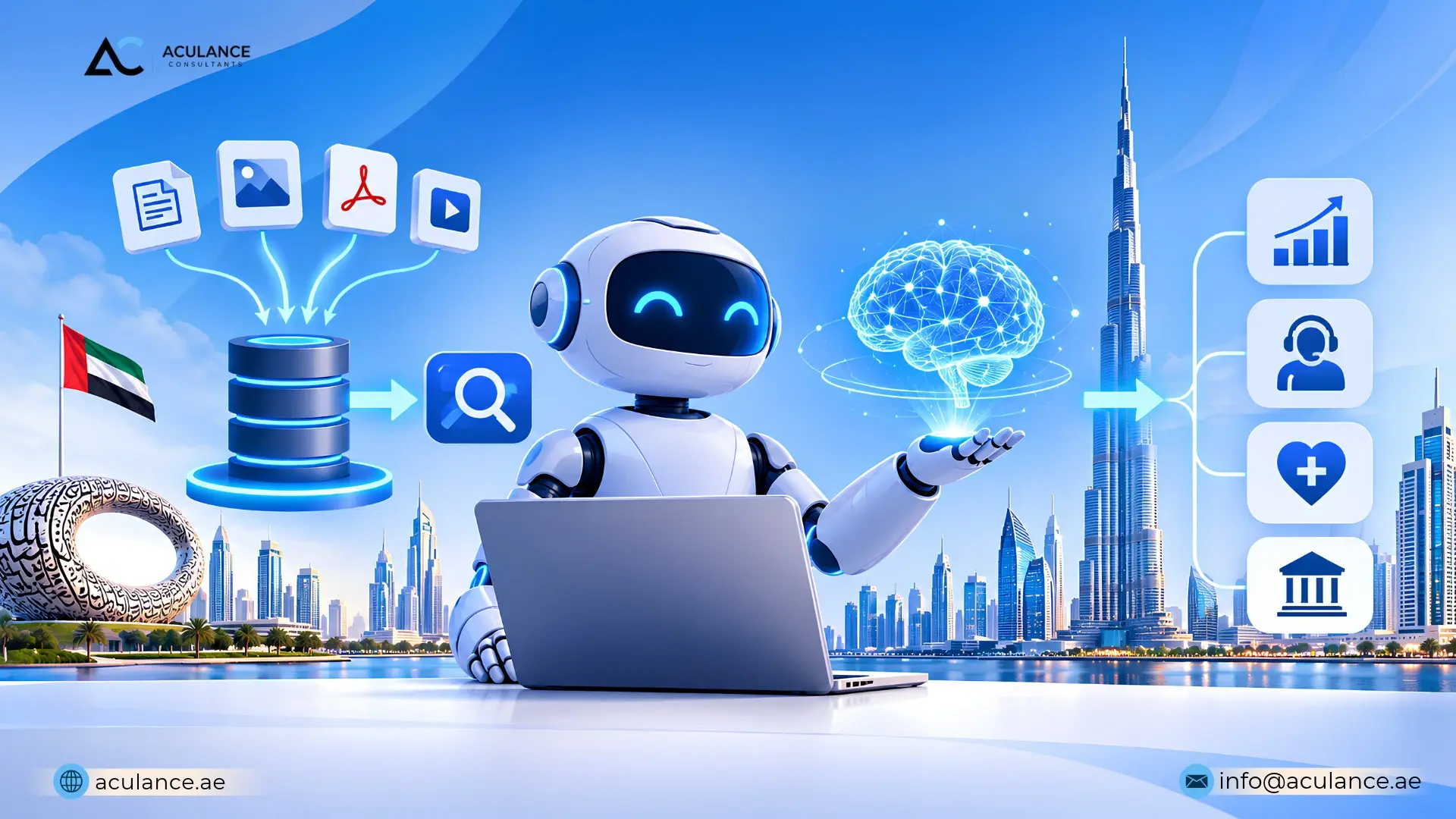
A typical RAG workflow involves six stages:
Data ingestion: Collect information from PDFs, websites, databases, CRM platforms, and internal documents.
Document processing: Clean the information, divide documents into smaller sections, and extract useful metadata.
Embedding generation: Convert text into numerical representations that capture semantic meaning.
Information retrieval: Search a vector database to identify information relevant to the user’s question.
Context augmentation: Provide the retrieved information to an LLM as additional context.
Response generation: Generate a natural-language answer based on the question and retrieved information.
The result is an AI application that can respond using organization-specific knowledge rather than relying exclusively on general model training.
Understanding RAG Architecture and Its Core Components
A reliable enterprise RAG solution requires several interconnected components. Each component contributes to retrieval quality, response accuracy, security, and overall system performance.
1. Data Ingestion and Processing
The process begins by collecting information from different business sources, including company documents, databases, APIs, websites, and enterprise applications.
The collected information is cleaned, standardized, and prepared for further processing. Document chunking divides large files into smaller, meaningful sections so the retrieval system can identify relevant content efficiently.
2. Embedding Models and Vector Databases
Embedding models transform text into numerical vectors that represent semantic meaning. These vectors are stored in specialized databases such as Pinecone, Qdrant, or PostgreSQL with pgvector.
When a user submits a question, the system converts it into an embedding and searches for semantically related information.
3. Retrieval and Context Augmentation
The retrieval component identifies relevant document sections using semantic search, keyword search, or hybrid retrieval.
The selected information is then added to the LLM prompt as context. More advanced systems may use reranking techniques to improve the relevance of retrieved results.
4. Large Language Model Integration
The LLM uses the user’s question and retrieved information to generate a response. Businesses can integrate suitable models depending on their performance, security, cost, and deployment requirements.
5. Security and Monitoring
Enterprise RAG systems should include authentication, role-based access control, encryption, audit logging, and monitoring. These controls help ensure users retrieve only information they are authorized to access.
Why Are UAE Businesses Adopting RAG Implementation?
Businesses in the UAE operate across competitive and information-intensive industries. They frequently manage large volumes of customer information, contracts, operational records, and internal documentation.
RAG helps make this information easier to access through conversational AI applications.
Some important benefits include:
Improved information accessibility: Employees can find relevant business information without manually searching multiple documents.
Context-aware responses: AI applications can use company-specific knowledge to answer questions more accurately.
Better customer support: Intelligent assistants can retrieve product details, service information, and support policies.
Operational efficiency: Organizations can reduce repetitive information-searching tasks.
Knowledge management: Businesses can make internal expertise more accessible across departments.
Scalable AI adoption: Companies can expand AI capabilities by connecting additional knowledge sources.
However, RAG does not automatically eliminate hallucinations. Retrieval quality, data accuracy, prompt design, and system evaluation remain essential.
Top Business Applications of RAG Across Industries in the UAE
RAG technology can support different business processes depending on the organization’s data and operational requirements.
1. Banking and Financial Services
Financial institutions can implement RAG-powered assistants to retrieve internal policies, product documentation, compliance information, and customer service guidelines. Employees can access relevant information through natural-language queries.
2. Healthcare
Hospitals and healthcare organizations can use RAG for administrative knowledge retrieval, medical document search, and internal policy assistance. Applications involving patient information require appropriate privacy safeguards and professional oversight.
3. Real Estate
Real estate companies can develop AI assistants that retrieve property details, contract information, project documentation, and tenant service policies. This can simplify information access for agents, buyers, and property managers.
4. Retail and E-commerce
Retail businesses can use RAG to power product discovery, answer questions about product specifications, and retrieve delivery or return policies. These applications can improve customer access to relevant information.
5. Logistics and Supply Chain
Logistics companies can connect RAG systems with shipment records, operational documents, inventory information, and supplier databases. Employees can retrieve important information without searching multiple platforms manually.
6. Government and Public Services
Government organizations can explore RAG-powered information assistants to help users find relevant public service information, procedures, and policy documents. Multilingual capabilities can make these systems more accessible.
Step-by-Step RAG Implementation Process in UAE
Developing a production-ready RAG application requires more than connecting an LLM to a vector database. A structured development approach helps organizations achieve reliable results.
Step 1: Identify Business Requirements
Define the problem, target users, expected outcomes, and information sources. Select a practical use case that can deliver measurable business value.
Step 2: Prepare Enterprise Data
Collect relevant documents and databases, evaluate data quality, remove outdated information, and establish appropriate access permissions.
Step 3: Select the Technology Stack
Choose suitable LLMs, embedding models, vector databases, cloud infrastructure, and integration technologies based on project requirements.
Step 4: Develop the Retrieval Pipeline
Implement document parsing, chunking, embedding generation, vector indexing, and retrieval mechanisms.
Step 5: Integrate the LLM
Connect the retrieval pipeline with the selected language model. Develop prompts that guide the model to answer using retrieved context and acknowledge insufficient information.
Step 6: Implement Security Controls
Configure authentication, authorization, encryption, access restrictions, and audit logging.
Step 7: Test and Optimize
Evaluate retrieval relevance, answer accuracy, response consistency, latency, and security. Improve chunking, search strategies, and prompts based on test results.
Step 8: Deploy and Maintain
Deploy the application, monitor performance, refresh the knowledge base, and continuously improve the system using feedback and evaluation results.
RAG Development Cost in UAE: How Much Does It Cost?
The cost of RAG development in UAE depends on application complexity, data volume, integration requirements, infrastructure, and security expectations.
A simple internal knowledge assistant requires fewer resources than a multilingual enterprise platform connected to multiple business systems.
The following figures are illustrative planning estimates, not verified UAE market averages or fixed development quotations.
| RAG solution type | Indicative development cost |
|---|---|
| Basic RAG prototype | AED 20,000–45,000 |
| Production-ready RAG application | AED 45,000–120,000 |
| Enterprise RAG solution | AED 120,000–300,000+ |
Actual project costs can fall outside these ranges depending on scope and implementation requirements.
Factors Affecting RAG Development Costs
Several technical and business factors influence the overall investment:
Data complexity: Large, unstructured, or inconsistent datasets require additional preparation.
LLM selection: Model capabilities, API usage, and deployment choices affect costs.
Vector database: Hosting, storage, indexing, and query requirements influence infrastructure expenses.
System integration: Connecting CRM, ERP, websites, and internal applications increases development effort.
Security requirements: Enterprise access controls, encryption, and compliance-related implementation add complexity.
Multilingual capabilities: Arabic and English support may require additional language processing and evaluation.
Maintenance: Hosting, model usage, monitoring, and knowledge-base updates contribute to recurring expenses.
Businesses should also budget separately for ongoing cloud infrastructure, LLM API consumption, and maintenance.
How to Choose the Right RAG Development Company in UAE
Selecting an experienced development partner is important for building a reliable enterprise AI solution.
Before choosing a RAG development company in UAE, evaluate its expertise in LLM integration, vector databases, semantic search, data engineering, and enterprise software development.
Review previous projects, technical capabilities, security practices, and experience integrating AI with existing business systems.
A capable development partner should also explain the proposed architecture, implementation timeline, infrastructure requirements, and estimated costs clearly.
Driving Business Innovation in UAE with RAG Implementation
Retrieval-Augmented Generation is creating new opportunities for UAE businesses to connect generative AI with their internal knowledge and operational data. From banking and healthcare to real estate, retail, and logistics, RAG applications can improve information accessibility and support more efficient business processes.
However, successful implementation depends on more than selecting an LLM. Organizations need reliable data pipelines, effective retrieval mechanisms, secure architecture, and continuous performance evaluation.
Businesses planning RAG implementation in UAE should begin with a clearly defined use case, choose technology according to their requirements, and develop a scalable solution that can grow with their operations.
Transform Your Business with RAG Technology
Frequently Asked Questions
1. What is RAG implementation in UAE?
RAG implementation in UAE involves developing AI applications that connect large language models with business-specific knowledge sources to generate relevant, context-aware responses.
2. How much does RAG development cost in UAE?
An indicative budget can range from AED 20,000 for a basic prototype to AED 300,000 or more for an enterprise-grade solution, depending on complexity and integrations.
3. How long does it take to develop a RAG application?
A basic proof of concept may take approximately 3–6 weeks, while production-ready and enterprise implementations can require several months.
4. Which industries can benefit from RAG technology?
Banking, healthcare, real estate, retail, logistics, education, and government organizations can benefit from RAG-powered knowledge retrieval and AI assistance.
5. Is RAG better than fine-tuning?
RAG is useful when applications need access to frequently updated external knowledge. Fine-tuning is more suitable for adapting model behavior, style, or specialized task performance. The right approach depends on the use case.