
A patient visits a hospital’s website late at night. They want to know whether a clinic is open, how to prepare for an appointment, or where to find their test results. Rather than waiting until morning, they open the website’s chatbot and type a question. Within seconds, they receive a helpful reply.
That interaction seems simple. Behind the scenes, however, the chatbot may be handling information that is private and legally protected. If it collects symptoms, appointment details, medication questions, or information connected to a medical record, the organization must think carefully about how that data is stored, processed, shared, and protected.
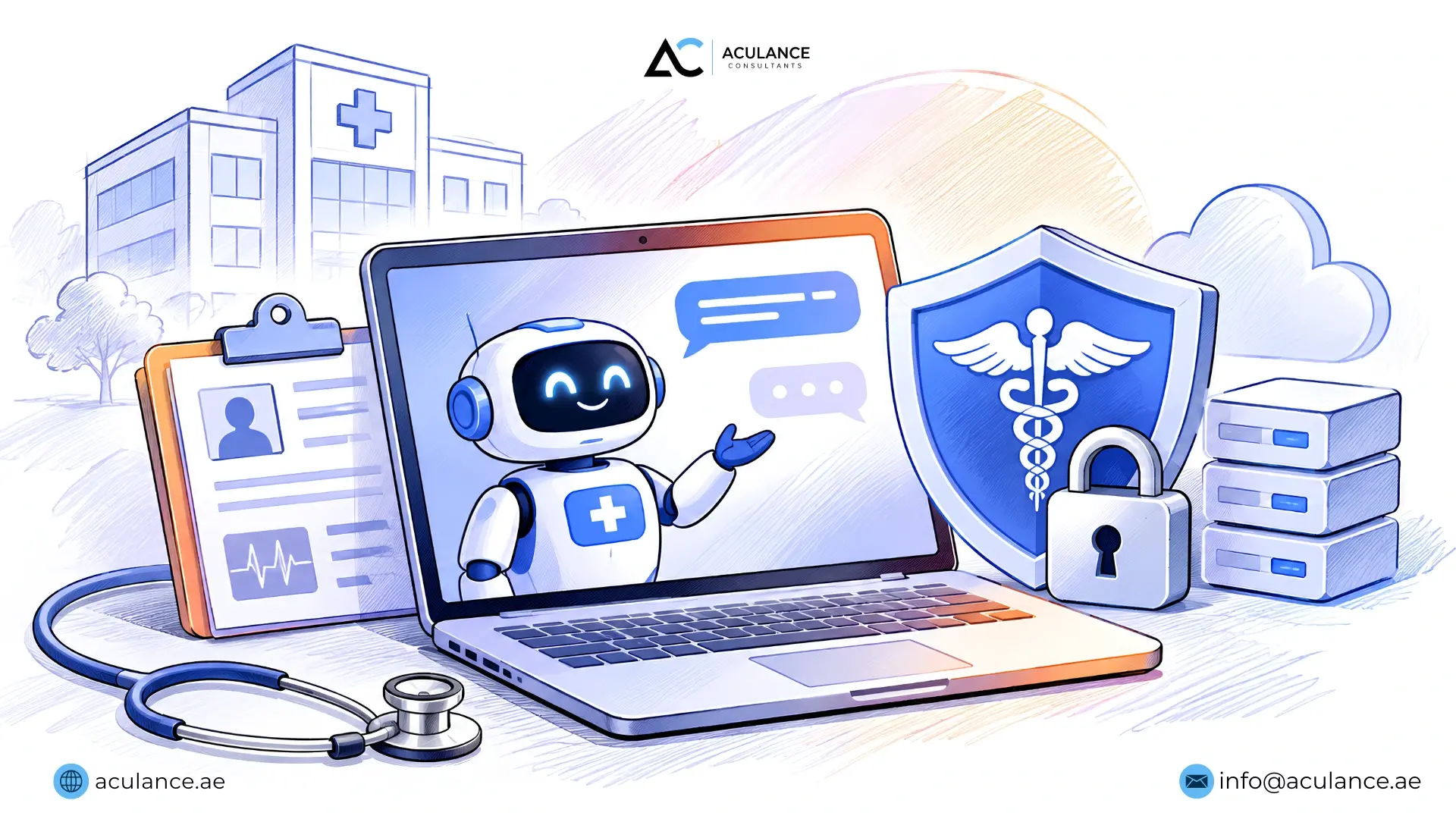
This is where HIPAA-compliant AI chatbot development becomes important. Healthcare organizations can use AI to make communication faster and more accessible, but they cannot treat patient information like ordinary website data. A secure chatbot needs the right architecture, clear privacy rules, carefully selected vendors, and appropriate agreements.
Let’s break down what that involves in practical terms.
What Makes an AI Chatbot HIPAA Compliant?
HIPAA, the Health Insurance Portability and Accountability Act, sets national standards in the United States for protecting certain health information. The rules apply to covered entities, such as healthcare providers, health plans, and healthcare clearinghouses, as well as business associates that handle protected health information (PHI) on their behalf.
A chatbot is not automatically HIPAA compliant because it uses a well-known AI model, runs on a secure cloud platform, or includes a privacy statement. Compliance depends on the complete service: the organization’s workflows, the chatbot application, the infrastructure, the vendors involved, and the safeguards used to protect PHI.
It is also important to understand that HIPAA does not issue a general certification for an individual AI model or chatbot. Organizations must assess how the technology is configured and used against the HIPAA requirements that apply to them.
A tool that is suitable for answering general questions may not be suitable for conversations that contain identifiable patient information.
Why HIPAA Matters for Healthcare Chatbots
Healthcare conversations can contain sensitive details even when a user does not intend to share them. A person might enter their name, date of birth, symptoms, diagnosis, insurance information, or details about a prescription. When those details identify an individual and relate to their health or healthcare, they may be PHI.
If a chatbot exposes that information, sends it to an unapproved service, or retains it longer than necessary, the consequences can extend beyond a technical problem. Patients may lose trust in the organization, the organization may face regulatory and contractual consequences, and the incident may require investigation and notification.
A thoughtful compliance approach also improves the product itself. Clear data boundaries, limited access, and well-defined escalation paths make it easier to understand what the chatbot can do and when a human team member should take over.
Understanding the Business Associate Agreement (BAA)
A Business Associate Agreement, usually called a BAA, is a written agreement between a HIPAA-regulated entity and a business associate. It sets out how the business associate may use or disclose PHI and what safeguards it must maintain.
If a healthcare organization uses an outside company to host, operate, support, or process PHI for its chatbot, that company may be acting as a business associate.
The agreement is not just a formality to sign before launch. It should reflect the actual service and the way data moves through it.
Depending on the architecture, relevant providers may include:
- Cloud hosting companies
- AI platform providers
- Chatbot vendors
- Analytics providers
- Customer-support platforms
- Other integration partners
The organization should determine which parties handle PHI and whether the required agreements are in place.
What Should a BAA Cover?
A BAA generally describes the permitted uses and disclosures of PHI, requires appropriate safeguards, and addresses reporting of security incidents and breaches.
It also covers matters such as:
- Subcontractors and their obligations
- Access to relevant records
- Support for individual rights, where applicable
- Reporting of security incidents and breaches
- Return or destruction of PHI when the relationship ends
The exact language should be reviewed by qualified legal and privacy professionals. A standard vendor contract or a general promise to keep data confidential is not necessarily a substitute for a BAA.
The agreement should match the service being purchased, including the features and data flows that will actually be enabled.
Questions to Ask Before Choosing an AI Vendor
Before connecting a chatbot to patient-facing workflows, ask vendors direct questions:
- Will the vendor sign a BAA for the specific product and service being used?
- Which data is sent to the AI model?
- Are prompts and outputs retained, and for how long?
- Is customer data used to train or improve models?
- Which subprocessors may receive the information?
- Where is data stored, and how can it be deleted?
Also ask how the vendor handles:
- Access controls
- Encryption
- Audit records
- Incident response
- Backups
- Support access
Do not assume that a company’s willingness to sign a BAA means every feature in its product is covered. Confirm that the agreement applies to the exact plan, API, configuration, and integrations you intend to use.
Protecting PHI in an AI Chatbot
A BAA is an important part of the compliance picture, but it does not secure an application by itself. The development team must build privacy and security into the chatbot from the start.
The following safeguards provide a practical foundation.
1. Encrypt Data in Transit and at Rest
Use strong, current encryption to protect information as it travels between the user, chatbot, application server, AI service, and connected systems.
Encrypt stored data as well, including conversation records, logs, backups, and exported files where they contain PHI.
Encryption settings should be reviewed and maintained as the system changes.
2. Apply Role-Based Access Controls
Not every employee or service needs access to every conversation.
Role-based access controls limit information to people and systems that need it for an authorized purpose.
Use:
- Unique user accounts
- Strong authentication
- Least-privilege permissions
- Periodic access reviews
Administrative access should be especially restricted and monitored.
3. Maintain Audit Logs and Monitoring
Keep records of important events, such as logins, permission changes, access to sensitive records, and relevant administrative actions.
Logs help security teams investigate unusual activity and understand what happened if an incident occurs.
They should be protected from tampering and configured so that they do not unnecessarily capture full PHI in plain text.
4. Minimize the Data You Collect
A chatbot should only ask for information that is needed to complete its task.
If a visitor wants to know clinic hours, there is no reason to request a medical record number.
If identity verification is required for a patient-specific task, collect only the details needed for that verification and use an approved process.
Data minimization reduces the amount of sensitive information that could be exposed, retained, or sent to an external service. It also makes the chatbot easier for patients to use.
5. Review AI APIs and Third-Party Integrations
An AI chatbot rarely works in isolation. It may connect to a language model, cloud database, electronic health record (EHR), appointment system, messaging provider, analytics service, or customer-support tool.
Each connection creates a potential path for information to move.
Map those paths before launch. Identify:
- What data each service receives
- Why it receives that data
- How long the information is retained
- Whether the provider is permitted to handle PHI
Disable unnecessary integrations and avoid sending identifiable information to tools that have not been approved for that purpose.
6. Add AI-Specific Safety Controls
Traditional application security is necessary, but generative AI introduces additional risks.
A chatbot may:
- Produce inaccurate medical information
- Follow malicious instructions embedded in user input or retrieved content
- Reveal information that should remain private
Teams should test for prompt injection, unsafe responses, and attempts to access another user’s data.
Use approved knowledge sources, limit the information the model can retrieve, and validate permissions outside the model.
The AI should never be the component that decides whether a user is authorized to see a medical record. Enforce access rules in the application and connected systems.
Provide clear boundaries for medical advice and route urgent or complex concerns to qualified professionals.
A Practical Roadmap for Developing a HIPAA-Compliant AI Chatbot
The safest way to build a healthcare chatbot is to treat compliance as part of product planning rather than a final checklist.
These steps can help teams move from an idea to a controlled deployment.
1. Define the Chatbot’s Purpose
Start with a narrow, clear use case.
The chatbot might:
- Answer general questions
- Help users find healthcare services
- Support appointment scheduling
- Provide access to approved patient information
Decide what it should not do as well.
A bot designed for clinic FAQs has a different risk profile from one that retrieves test results.
2. Map the Data Flows
Document what users may enter, what the application collects, where information is sent, what is stored, and which people or vendors can access it.
Classify the data and identify where PHI may appear, including in:
- Prompts
- AI-generated outputs
- Logs
- Analytics
- Backups
- Support tickets
3. Select Suitable AI and Cloud Providers
Evaluate providers based on their:
- Security capabilities
- Contractual commitments
- Data-use policies
- Retention settings
- Ability to support the intended HIPAA-regulated workflow
Confirm BAA availability for the exact services being used.
Avoid making a vendor decision based only on model quality or price.
4. Design a Secure Application Architecture
Keep authentication, authorization, data validation, and business rules in trusted application services.
Use:
- Secure secrets management
- Network controls
- Encryption
- Separation between development, testing, and production environments
Do not place API keys or sensitive credentials in client-side code.
5. Integrate with EHR Systems Carefully
If the chatbot needs patient information, connect through approved interfaces and apply the EHR’s access controls.
Standards such as HL7 and FHIR may support interoperability, but using a standard does not remove the need for:
- Authentication
- Authorization
- Consent and purpose checks
- Careful handling of returned data
6. Set Guardrails and Human Handoff Rules
Define which questions the chatbot can answer, which topics require a disclaimer, and which situations must be transferred to a staff member or emergency pathway.
Do not let the chatbot diagnose conditions or make treatment decisions beyond its approved role.
Make it easy for users to reach a person when needed.
7. Test Security, Privacy, and Response Quality
Test ordinary conversations as well as edge cases, including:
- Users entering excessive personal details
- Attempts to retrieve another patient’s information
- Prompt injection
- Incorrect answers
- Session timeouts
- Unexpected system errors
Include privacy, security, clinical, and accessibility reviews before release.
8. Monitor and Improve After Launch
A launch is not the end of the work.
Monitor:
- Performance
- Access patterns
- Security incidents
- User feedback
Review vendor changes, model updates, integrations, and retention settings.
Reassess risks when the chatbot gains new features or begins handling additional categories of information.
Read More:- How UAE Healthcare Businesses Build Scalable AI-Powered Digital Solutions
Common Mistakes to Avoid
1. Assuming a Popular AI Model Is Automatically HIPAA Compliant
Compliance depends on the complete service, its configuration, contracts, and safeguards—not the model name.
2. Signing a BAA Without Reviewing the Data Flow
A contract cannot protect information that is being sent to an unapproved integration or retained in an overlooked log.
3. Collecting More Information Than the Chatbot Needs
Avoid asking for identifiers or health details when a general answer would be enough.
4. Giving the AI Too Much Access
The model should not have broad, unrestricted access to patient records.
Enforce permissions in the application layer.
5. Skipping Ongoing Testing and Monitoring
New prompts, model versions, integrations, and product features can introduce risks after launch.
The Future of Secure AI Chatbots in Healthcare
AI chatbots can make healthcare communication more convenient, help patients find information, and reduce the pressure on administrative teams.
But when a chatbot handles protected health information, convenience must be balanced with privacy, security, and accountability.
A strong HIPAA-compliant chatbot project starts with a clearly defined purpose, a realistic understanding of where PHI travels, suitable BAAs, and safeguards built into the application. It also needs careful vendor evaluation, controlled EHR integrations, AI-specific testing, human oversight, and continuous monitoring.
There is no single checkbox that makes the whole system compliant; it is the combination of sound decisions throughout development and operation that matters.
If your healthcare organization is exploring an AI chatbot, Aculance can help you plan an implementation that puts usability, secure architecture, and responsible handling of patient information at the center. Start with the use case, understand the data, and build the right safeguards before the first patient conversation begins.
Ready to Build a HIPAA-Compliant AI Chatbot
Frequently Asked Questions
1. What is a HIPAA-compliant AI chatbot?
A HIPAA-compliant AI chatbot protects patient health information using encryption, access controls, secure data handling, and appropriate privacy safeguards.
2. Does an AI chatbot need a BAA to be HIPAA compliant?
A BAA is generally required when a vendor handles PHI on behalf of a covered entity. It defines permitted data use, security safeguards, and breach reporting.
3. How can AI chatbots protect PHI in healthcare?
AI chatbots protect PHI through encryption, role-based access, secure authentication, audit logs, data minimization, and regular security assessments.
4. Can AI chatbots integrate with EHR systems securely?
Yes, AI chatbots can securely integrate with EHR systems using HL7 or FHIR APIs, authentication, authorization, and safeguards to protect patient data.
5. Is HIPAA certification available for AI chatbots?
No, HIPAA does not certify individual AI chatbots. Compliance depends on the system’s configuration, vendor agreements, safeguards, and data handling.