
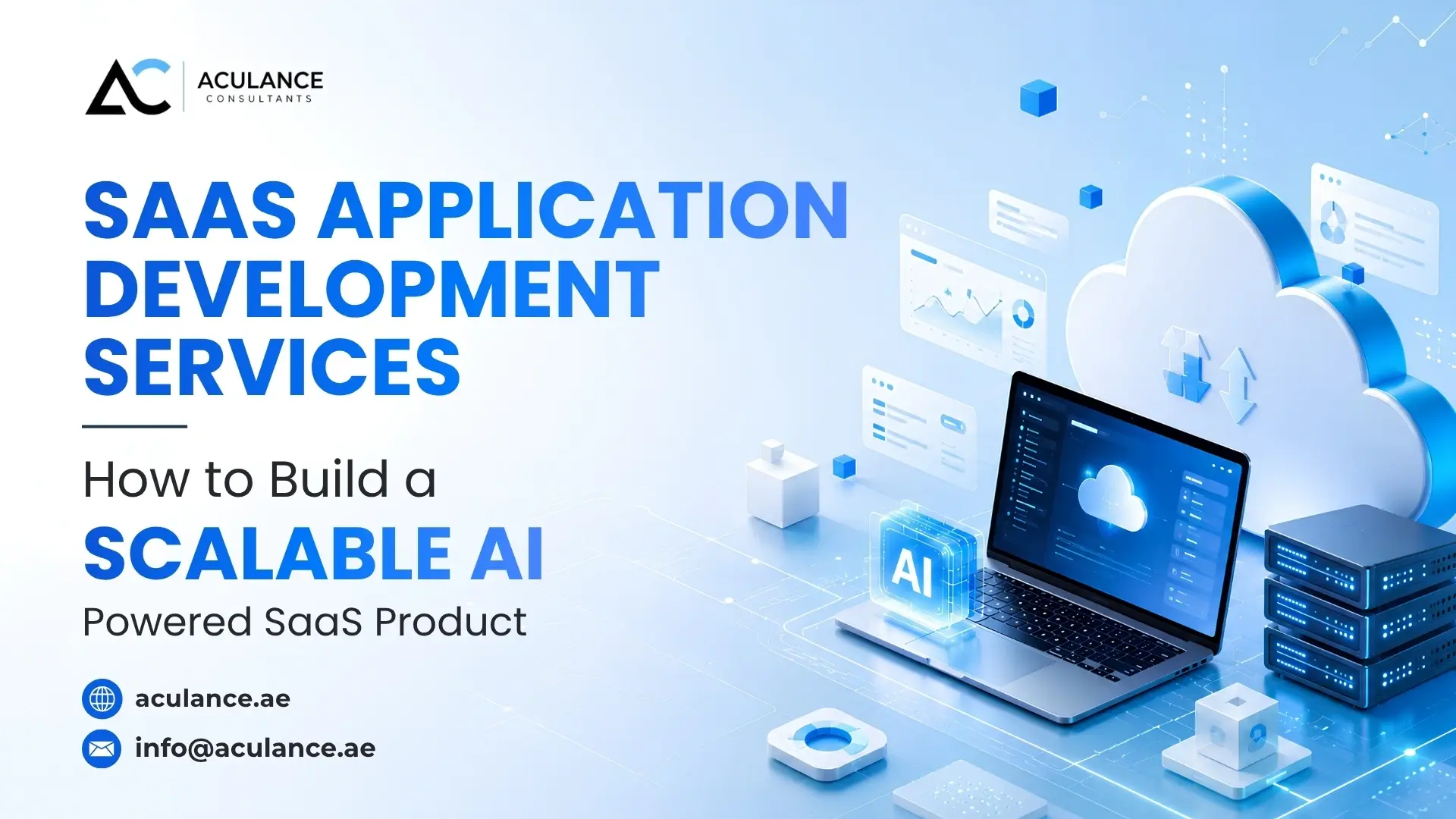
SaaS application development is the process of designing, building, deploying, and scaling cloud-based software that users access through the internet. Unlike traditional software that requires installation on individual devices, SaaS products are centrally hosted and typically delivered through subscription or usage-based models.
Modern SaaS development goes beyond cloud deployment. Businesses increasingly expect SaaS platforms to provide AI-powered automation, real-time analytics, seamless integrations, personalization, and enterprise-grade security.
A scalable SaaS product combines the right technology architecture with a clear product strategy, allowing businesses to support growing users, increasing data volumes, and evolving customer requirements without compromising performance.
Why Is SaaS Application Development Important for Businesses?
SaaS has become a preferred software delivery model because it offers flexibility, faster deployment, centralized updates, and predictable access to business applications.
For organizations, a well-designed SaaS application can:
- Reduce infrastructure and maintenance requirements
- Provide software access from multiple devices and locations
- Support subscription-based revenue models
- Enable faster product updates
- Integrate with third-party applications and APIs
- Scale resources as customer demand grows
- Introduce AI-powered automation and analytics
- Improve customer experience through personalization
However, simply moving software to the cloud does not make it scalable. The underlying architecture, database, APIs, security model, infrastructure, and development practices must all be designed for growth.
Key Components of a Scalable SaaS Product
A successful SaaS application requires several technical components working together.
| Component | Purpose | Scalability Benefit |
|---|---|---|
| Cloud Infrastructure | Hosts the application and services | Supports changing workloads |
| API Architecture | Connects applications and services | Enables integrations and expansion |
| Database Architecture | Stores and manages application data | Handles growing data volumes |
| AI & Machine Learning | Provides intelligent capabilities | Enables automation and personalization |
| Security | Protects users and business data | Builds trust and supports enterprise adoption |
| Monitoring | Tracks application health and performance | Helps identify issues before they affect users |
The right architecture depends on the product’s complexity, expected traffic, business model, budget, and long-term roadmap. A modular architecture may be sufficient for an early-stage SaaS product, while larger platforms may benefit from microservices or other distributed architectures.
How AI Is Changing SaaS Application Development
AI is rapidly becoming one of the most important capabilities in modern SaaS products. Instead of functioning only as a standalone chatbot, AI can be integrated directly into business workflows.
AI-Powered SaaS Applications Can:
Automate repetitive tasks: AI can classify documents, summarize information, route support tickets, process requests, and automate workflows.
Provide intelligent recommendations: Machine learning can analyze user behavior and business data to recommend products, actions, or next steps.
Improve decision-making: AI-powered analytics can identify patterns and generate insights from large datasets.
Enable natural-language interfaces: Users can interact with applications using conversational queries rather than navigating multiple screens.
Personalize user experiences: AI can customize recommendations, dashboards, notifications, and content according to user behavior.
Generate business content: Generative AI can help create reports, summaries, descriptions, emails, documentation, and other business content.
For example, an AI-enabled ERP SaaS platform could analyze operational data and provide management with insights into inventory trends, purchasing patterns, or financial performance.
The key is to implement AI where it solves a genuine business problem. Adding AI merely as a marketing feature does not guarantee product value.
How to Build a Scalable SaaS Product
Building a scalable SaaS application requires a structured development process.
1. Identify the Business Problem
Start by defining the customer problem your product will solve. Research your target audience, competitors, market requirements, and potential differentiators.
A clear value proposition helps determine which features should be included in the initial product.
2. Define the MVP
A Minimum Viable Product (MVP) focuses on the essential features required to solve the primary customer problem.
Instead of building every possible feature, prioritize functionality that can be tested with real users. Feedback from early customers can then guide future development.
3. Choose the Right Technology Architecture
Architecture directly affects scalability, performance, security, and development costs.
Depending on requirements, SaaS applications may use:
- Cloud-native infrastructure
- Modular application architecture
- Microservices
- REST or GraphQL APIs
- Containers
- Managed databases
- Caching systems
- Automated CI/CD pipelines
An experienced custom software development company can evaluate these options based on the product’s expected growth rather than choosing technology simply because it is popular.
4. Design for Multi-Tenancy
Many SaaS applications serve multiple customers from shared infrastructure. This is known as a multi-tenant architecture.
Tenant isolation is critical because each organization’s users and data must remain properly separated. Authentication, authorization, encryption, access controls, audit logs, and secure data handling should therefore be considered from the beginning.
5. Integrate AI and Automation
After establishing the core product workflow, businesses can introduce AI capabilities where they create measurable value.
Depending on the application, this may include:
- Generative AI
- AI copilots
- Predictive analytics
- Recommendation engines
- Intelligent search
- Document processing
- Automated workflows
- Natural-language interfaces
AI implementation should also include monitoring, data governance, human oversight, and appropriate privacy controls.
6. Test Performance and Security
Testing is essential before launching a SaaS product. Functional testing verifies that features work correctly, while performance testing determines how the application behaves under different workloads.
Security testing should address authentication, authorization, API security, data protection, vulnerabilities, and tenant isolation.
Load testing is particularly important for SaaS products because unexpected traffic growth can expose architectural weaknesses.
7. Deploy, Monitor, and Optimize
Launching the application is only the beginning. SaaS products require continuous monitoring, maintenance, security updates, performance optimization, and feature improvements.
Application monitoring can track metrics such as:
- Response times
- Server utilization
- Error rates
- Database performance
- User activity
- API performance
- Infrastructure costs
These insights help development teams identify bottlenecks and improve the product as usage increases.
SaaS Development Process: From Idea to Scalable Product
| Development Stage | Key Activities | Outcome |
|---|---|---|
| Discovery | Market research, requirements, competitor analysis | Product strategy |
| UI/UX Design | User flows, wireframes, prototypes | User-focused experience |
| MVP Development | Core features and integrations | Initial product |
| AI Integration | Automation, analytics, intelligent features | AI-powered capabilities |
| Testing | Functional, security, performance, load testing | Reliable application |
| Deployment | Cloud deployment and monitoring | Production-ready SaaS |
| Optimization | Analytics, updates, scaling, maintenance | Long-term growth |
SaaS, ERP, and IoT: How They Work Together
SaaS development can extend beyond standalone business applications.
For enterprises, ERP software development can use the SaaS model to deliver cloud-based financial, inventory, supply chain, HR, CRM, and operational capabilities.
Similarly, IoT software development can connect SaaS platforms with sensors and connected devices. IoT-enabled SaaS applications can collect real-time device data, monitor equipment, generate alerts, analyze performance, and provide centralized dashboards.
When combined with AI, these technologies can create intelligent business ecosystems.
For example:
IoT devices → SaaS platform → Data analytics → AI insights → Automated business action
This approach can help businesses move from simply collecting data to making faster, data-driven decisions.
How Much Does SaaS Application Development Cost?
The cost of SaaS application development varies significantly depending on product complexity and business requirements.
Key cost factors include:
- Number and complexity of features
- UI/UX requirements
- AI functionality
- Cloud infrastructure
- Third-party integrations
- Security and compliance requirements
- Database architecture
- Development team location and expertise
- Testing and quality assurance
- Post-launch maintenance
An MVP will generally require less investment than an enterprise SaaS platform with advanced AI, ERP integrations, real-time analytics, and IoT connectivity.
The most practical approach is to define the MVP first and create a phased roadmap for future features.
Final Thoughts
Building a scalable SaaS product requires more than developing a collection of software features. Businesses need a strong product strategy, scalable architecture, secure infrastructure, intuitive UX, reliable testing, and continuous optimization.
AI is adding another layer of opportunity by enabling SaaS applications to automate processes, generate insights, personalize experiences, and support smarter business decisions.
Whether you are building a new SaaS startup, modernizing enterprise software, investing in ERP software development, or connecting devices through IoT software development, the right development strategy can create a platform capable of supporting long-term growth.
Partnering with an experienced custom software development company can help turn the initial SaaS concept into a secure, scalable, and AI-ready product built around real customer needs.
Frequently Asked Questions
What is SaaS application development?
SaaS application development is the process of building cloud-based software that users access online, typically through a subscription model.
How do you make a SaaS application scalable?
Use scalable cloud infrastructure, optimized databases, secure APIs, efficient architecture, and continuous performance monitoring.
How does AI improve SaaS applications?
AI enables automation, predictive analytics, personalization, intelligent search, recommendations, and generative AI features.
Should I hire a custom software development company for SaaS development?
Yes, especially for complex SaaS products requiring custom features, integrations, AI, security, and scalable architecture.
Can SaaS be used for ERP and IoT solutions?
Yes. SaaS can support cloud-based ERP systems and connect with IoT devices for real-time data collection and analysis.