

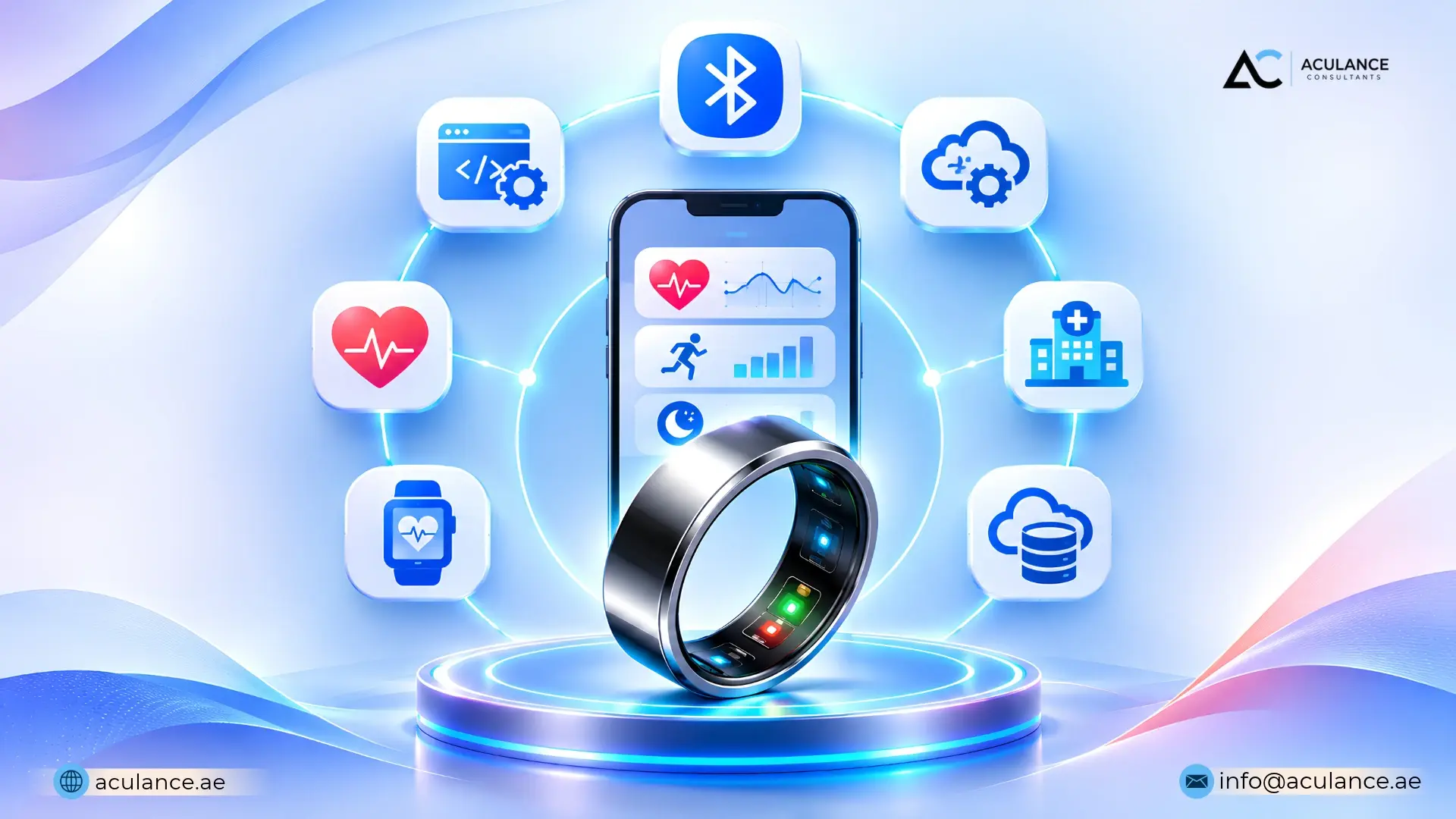
Wearable technology is transforming how people understand and manage their health. Among the latest innovations, smart rings are gaining attention for their compact design, continuous biometric tracking, and ability to collect health-related information without the bulk of traditional wearable devices. However, the real value of a smart ring extends beyond its hardware. A well-designed mobile application is essential for converting collected sensor data into meaningful insights.
Smart ring app development combines Bluetooth Low Energy (BLE), healthcare APIs, cloud computing, and data analytics to create connected health experiences. These technologies allow smart rings to communicate with smartphones, synchronize health information, and provide users with accessible wellness insights.
For businesses entering the wearable technology market, understanding how these components work together is essential to building scalable, secure, and user-friendly smart ring applications.
What Is Smart Ring App Development?
Smart ring app development is the process of building mobile and backend software that connects smart ring devices with digital platforms. These applications collect, process, display, and manage information generated by the ring’s embedded sensors.
Depending on the hardware capabilities, smart rings can track metrics such as heart rate, heart rate variability (HRV), sleep patterns, skin temperature, activity levels, and blood oxygen saturation (SpO2).
A typical smart ring ecosystem consists of four major components:
- Smart ring hardware: Contains sensors, a processor, memory, and a battery.
- Mobile application: Connects with the ring and displays health information.
- Backend infrastructure: Stores and processes synchronized data.
- Health APIs: Enable authorized information exchange with compatible health platforms.
Together, these components create a connected environment where users can monitor health trends through a smartphone rather than accessing raw sensor information directly.
Why Is BLE Technology Important in Smart Ring App Development?
Bluetooth Low Energy (BLE) is one of the most important technologies used in smart ring connectivity. Since smart rings have limited physical space and small batteries, they require communication protocols that can transfer data without unnecessarily consuming power.
BLE supports short-range wireless communication between a smart ring and a smartphone. It allows applications to retrieve available device information, synchronize recorded measurements, and manage connections efficiently.
How BLE Communication Works
BLE communication generally involves a central device and a peripheral device. In a typical smart ring ecosystem, the smartphone acts as the central device, while the smart ring operates as the peripheral.
The communication process involves several stages:
Device discovery: The smartphone scans for nearby BLE-enabled smart rings.
Pairing and connection: The application establishes a connection with the selected device.
GATT communication: The app accesses supported data through the Generic Attribute Profile (GATT).
Data synchronization: Available sensor measurements and device information are transferred.
Connection management: The application handles disconnections and reconnects when appropriate.
GATT organizes device information into services and characteristics. For example, a smart ring may expose battery information or manufacturer-specific sensor data through defined characteristics.
BLE vs. Traditional Bluetooth
Unlike Bluetooth Classic, which is commonly used for applications requiring continuous data streaming, BLE is designed for low-power communication and intermittent data exchange. This makes it suitable for compact wearable devices that collect information throughout the day and synchronize it periodically.
Developers should optimize connection intervals, data transfer frequency, background synchronization, and reconnection behavior to balance responsiveness with battery efficiency.
Essential Features of a Smart Ring Health Application
A successful smart ring application should do more than display measurements. It should help users understand their health patterns through accessible dashboards and meaningful information.
1. Real-Time Health Monitoring
The application can display supported biometric measurements, including heart rate, HRV, skin temperature, and SpO2. The availability and accuracy of these metrics depend on the ring’s sensors, algorithms, and validation.
2. Sleep Tracking and Analysis
Sleep monitoring is an important smart ring use case. Applications can present sleep duration, estimated sleep stages, overnight heart rate, and sleep consistency. Historical reports help users identify patterns and understand changes in their sleep routines.
3. Activity and Fitness Tracking
Activity tracking features can display steps, movement patterns, estimated calorie expenditure, and daily activity levels. These insights encourage users to maintain consistent physical activity.
4. Personalized Health Dashboard
A centralized dashboard makes health information easier to understand. Developers can use charts, trend comparisons, summaries, and personalized baselines to present information in a meaningful format.
5. Smart Notifications
Applications can send reminders about device synchronization, low battery levels, inactivity, and changes in selected health metrics. Notifications should be configurable to avoid unnecessary interruptions or misleading health alerts.
How to Integrate Health APIs Into Smart Ring Applications
Health API integration makes smart ring applications more useful by connecting wearable data with broader digital health ecosystems. Instead of keeping information isolated within one application, developers can enable authorized data exchange with compatible platforms.
Apple HealthKit Integration
Apple HealthKit provides a framework for managing health and fitness information across supported Apple devices and applications.
Smart ring applications can use HealthKit to read or write supported health records, depending on the available data types and user permissions. For example, an application may share eligible activity or heart rate records with Apple Health.
Developers must implement permission handling carefully and request access only to the information required by the application’s functionality.
Android Health Connect Integration
Health Connect provides Android applications with a standardized way to access and share supported health and fitness records.
A smart ring companion app can use Health Connect to exchange authorized data with compatible applications. This can help users maintain a more connected view of their activity, sleep, and other supported health information.
FHIR-Based Healthcare Integration
For applications designed to support healthcare workflows, Fast Healthcare Interoperability Resources (FHIR) can facilitate structured health information exchange between compatible systems.
FHIR-based integration may support connections with electronic health record (EHR) platforms and clinical applications. However, integrating smart ring measurements into clinical records requires careful attention to data provenance, accuracy, validation, and clinical relevance.
HealthKit, Health Connect, manufacturer SDKs, and FHIR serve different purposes. Selecting the right integration depends on the application’s target users and business requirements.
Smart Ring App Architecture: Connecting Devices, Applications, and Cloud Platforms
A scalable smart ring application requires an architecture that supports reliable communication and secure data management.
A typical architecture includes:
Device layer: Smart ring sensors collect biometric and activity information.
Connectivity layer: BLE transfers supported information to the mobile application.
Application layer: The mobile app manages pairing, synchronization, dashboards, and user interactions.
Backend layer: Cloud services manage accounts, data storage, processing, and application APIs.
Integration layer: Health APIs connect the application with compatible third-party platforms.
Analytics layer: Data processing systems generate trends and personalized insights.
For example, when a user wears a smart ring overnight, the device can record supported measurements. The mobile application retrieves available records through BLE synchronization. After processing, the application may securely transmit selected information to its backend and share eligible records with an authorized health platform.
This architecture separates device communication from health data management, making future upgrades and additional integrations easier.
Step-by-Step Smart Ring App Development Process
Building a smart ring application requires coordinated hardware, software, and integration planning.
Step 1: Define the Project Requirements
Identify the target audience, core features, supported health metrics, and business objectives. Decide whether the application will focus on general wellness or a medical purpose.
Step 2: Select Compatible Smart Ring Hardware
Evaluate available hardware, sensor capabilities, BLE specifications, manufacturer SDKs, and API documentation. Confirm that the device supports the data and integrations required by the application.
Step 3: Choose the Technology Stack
Select native iOS and Android development or cross-platform frameworks such as Flutter and React Native. Choose backend technologies, databases, and cloud infrastructure according to scalability and security requirements.
Step 4: Develop the UI/UX
Design an intuitive interface for onboarding, device pairing, health dashboards, notifications, and historical reports.
Step 5: Implement BLE and Health API Integrations
Develop secure device communication, data synchronization, connection recovery, and third-party health platform integrations.
Step 6: Test and Launch
Conduct functional, compatibility, BLE connectivity, battery consumption, performance, and security testing before releasing the application.
Security and Privacy in Connected Health Solutions
Smart ring applications handle personal information, making security an essential part of development rather than a feature added after launch.
Developers should implement encryption for data in transit and at rest, secure authentication, access controls, and appropriate user consent mechanisms. BLE pairing and communication should follow the device manufacturer’s security capabilities and current platform recommendations.
Healthcare applications must also consider applicable regulations. Depending on the product, intended use, and operating region, these may include HIPAA, GDPR, India’s Digital Personal Data Protection Act, and medical device software requirements.
It is equally important to distinguish wellness insights from medical diagnosis. A smart ring measurement should not be presented as a clinically validated result unless the device and intended functionality have appropriate supporting evidence.
How AI Can Improve Smart Ring Health Applications
Artificial intelligence and machine learning can make wearable applications more informative by identifying patterns across multiple measurements.
By integrating artificial intelligence services, smart ring applications can analyze an individual’s historical sleep, activity, and heart rate trends to generate contextual wellness insights. AI can also help identify unusual data patterns and support personalized recommendations.
However, these systems require reliable training data, appropriate validation, and transparent limitations. AI-generated insights should support user understanding rather than replace professional medical advice.
Challenges in Smart Ring App Development
Developers must address several technical challenges when building connected wearable applications:
BLE connectivity: Connection interruptions require reliable synchronization and recovery mechanisms.
Battery limitations: Frequent communication can reduce device battery life.
Sensor reliability: Motion, environmental conditions, and sensor placement can affect measurement quality.
API compatibility: Different platforms support different health data types and permissions.
Data security: Personal health information requires strong privacy and access controls.
Device dependency: Manufacturer-specific SDKs can limit interoperability and future flexibility.
A modular architecture, careful testing, and standardized data models can help address these challenges.
The Future of Smart Ring Apps
Smart ring app development brings together wearable hardware, BLE connectivity, healthcare APIs, cloud infrastructure, and intelligent data processing. Each component plays an important role in creating a reliable connected health experience.
For businesses planning to enter the wearable technology market, the priority should be building an application that combines seamless device connectivity with secure health data management and an intuitive user experience.
By investing in scalable architecture, reliable BLE integration, and interoperable health APIs, businesses can develop smart ring applications that support evolving wellness needs and connected healthcare solutions.
Planning to build a smart ring application? Partnering with an experienced wearable app development team can help transform your product concept into a secure, scalable, and feature-rich digital health solution.
Ready to Build Your Smart Ring App?
Frequently Asked Questions
1. What is smart ring app development and how does it work?
Smart ring app development connects wearable devices with mobile apps to collect, process, and display health data such as heart rate, sleep, and activity.
2. Why is BLE technology important in smart ring app development?
BLE enables smart rings to connect with mobile apps, synchronize sensor data, and maintain efficient wireless communication while minimizing battery consumption.
3. Which health APIs can be integrated into smart ring applications?
Smart ring apps can integrate Apple HealthKit, Android Health Connect, and HL7 FHIR to enable secure health data exchange across connected platforms.
4. What features should a smart ring health application include?
Essential features include heart rate monitoring, sleep tracking, activity analysis, health dashboards, smart notifications, and secure data synchronization.
5. How much does it cost to develop a smart ring application?
Smart ring app development costs depend on BLE integration, app complexity, hardware compatibility, health APIs, backend infrastructure, and security features.